
To visit the Musée d'Orsay, the districts that require the least amount of transportation are the 7th arrondissement, Saint-Germain-des-Prés (6th), and the 1st, on the other side of the Seine: between 10 and 20 minutes walking from the entrance, depending on the starting points we measured. The Latin Quarter, the Marais, and the neighborhoods near train stations are between 2.4 and 4.3 km away, so with one transfer; but the line 12 and the RER C arrive directly at the museum. This page compares these areas based on their connections to the museum, not based on their hotels: we do not mention any establishments, nor prices, because addresses and rates change faster than a guide.
Choose your neighborhood based on the line that goes to Orsay without a change, before considering the surroundings. Line 12 and the RER C serve the museum; a neighborhood on one of these lines is better than a neighborhood that is close by as the crow flies but without a connection.
Which train lines go to the Musée d'Orsay?
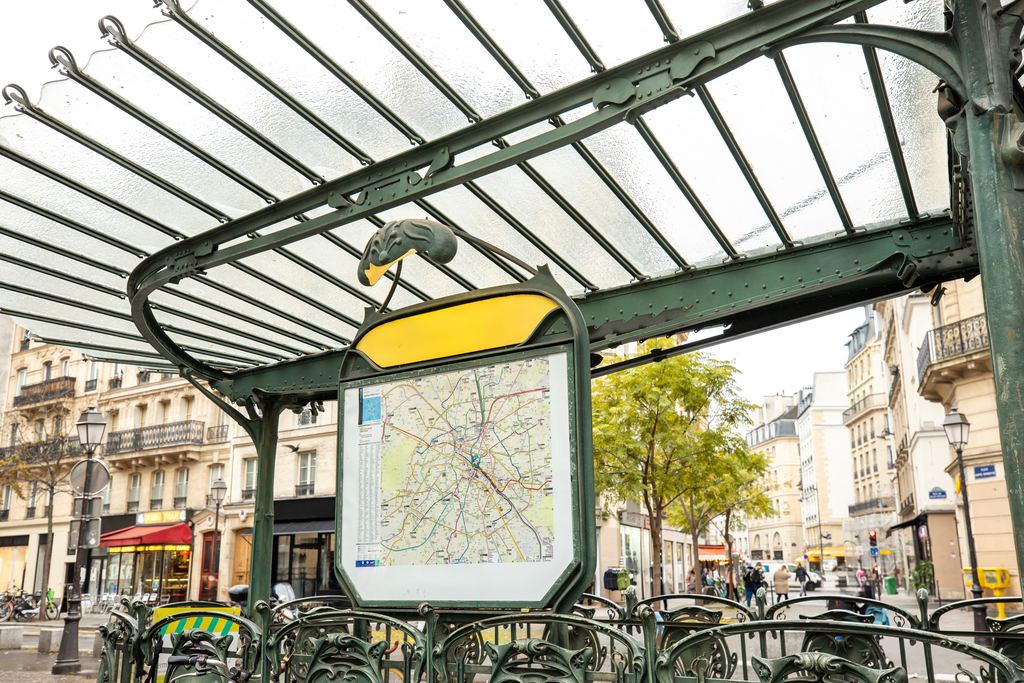
The museum's page dedicated to access, as of November 6, 2026, states: Metro line 12, station Solférino; RER C, station Musée d'Orsay; buses 63, 68, 69, 73, 83, 84, 87, and 94; Vélib' stations number 7007 (62 rue de Lille) and number 7006 (19 quai Voltaire). The RER station is less than 350 meters from the entrance. Bus routes and station numbers may change: please check ratp.fr or iledefrance-mobilites.fr before choosing accommodation based on a bus number.
Two facts derived from the line maps help to compare the stations. The line 12 connects, from north to south, the Saint-Lazare station area to the Montparnasse area, passing through Concorde and Solférino, then through Rue du Bac, Sèvres-Babylone, and Notre-Dame-des-Champs. The RER C serves the Austerlitz station, Saint-Michel–Notre-Dame, the Musée d'Orsay, Invalides, and Champ de Mars–Tour Eiffel. These are the stations in the Île-de-France Mobilités dataset (recorded for this guide); please confirm them on the official map.
Which neighborhood is best to stay in when visiting the Musée d'Orsay?
| Base | Museum connection | Walking distance from the entrance | For whom | Weak point |
|---|---|---|---|---|
| 7th arrondissement (including the Bon Marché department store, the Invalides district, and the Rue Cler) | You can reach us on foot, or by taking the RER C train (Invalides or Champ de Mars stations) | Bon Marché department store: approximately 1.4 kilometers, 19 minutes; Rue Cler: approximately 2.2 kilometers, 30 minutes | Quiet atmosphere, markets, and a morning museum visit | Rue Cler is too far to walk to; there's less activity in the evenings, so it's best to check it out in person |
| 6th arrondissement, Saint-Germain-des-Prés | By foot or by bus; line 12 (Rue du Bac, Sèvres-Babylone station) | Church: approximately 1.2 kilometers away, 16 minutes; cafes: 14-15 minutes | A first stay, featuring cafes and bookstores | Very popular cafes; prices are typical for a tourist area and can be found on-site |
| 1st (Tuileries, Palais-Royal) | Senghor Bridge; take metro line 12 from Concorde | Tuileries Garden: approximately 750 meters, 10 minutes; Place Vendôme: 17 minutes | Who wants to combine a visit to the Louvre and the Musée d'Orsay (see the combined ticket options)? | You need to cross the Seine River to reach the museum |
| Latin Quarter, 5th arrondissement | RER C (Saint-Michel–Notre-Dame, Austerlitz) | Pantheon: approximately 2,400 meters, 32 minutes; Sainte-Chapelle: approximately 1,700 meters | Students, long stays, bookstores | Whether it's a correspondence or a long walk |
| Marais, 4th arrondissement | No direct connection confirmed; a correspondence | Place des Vosges, 300 square meters, 44 minutes | Evenings, small museums | It's 3.3 km from the museum, which is quite a walk |
| Near a station | Line 12 from Saint-Lazare and Montparnasse; otherwise, a connection is required | Saint-Lazare station: approximately 2,600 meters, 35 minutes; Montparnasse station: approximately 2,800 meters, 37 minutes | Who is arriving or departing by train | Not a neighborhood for leisurely strolls |
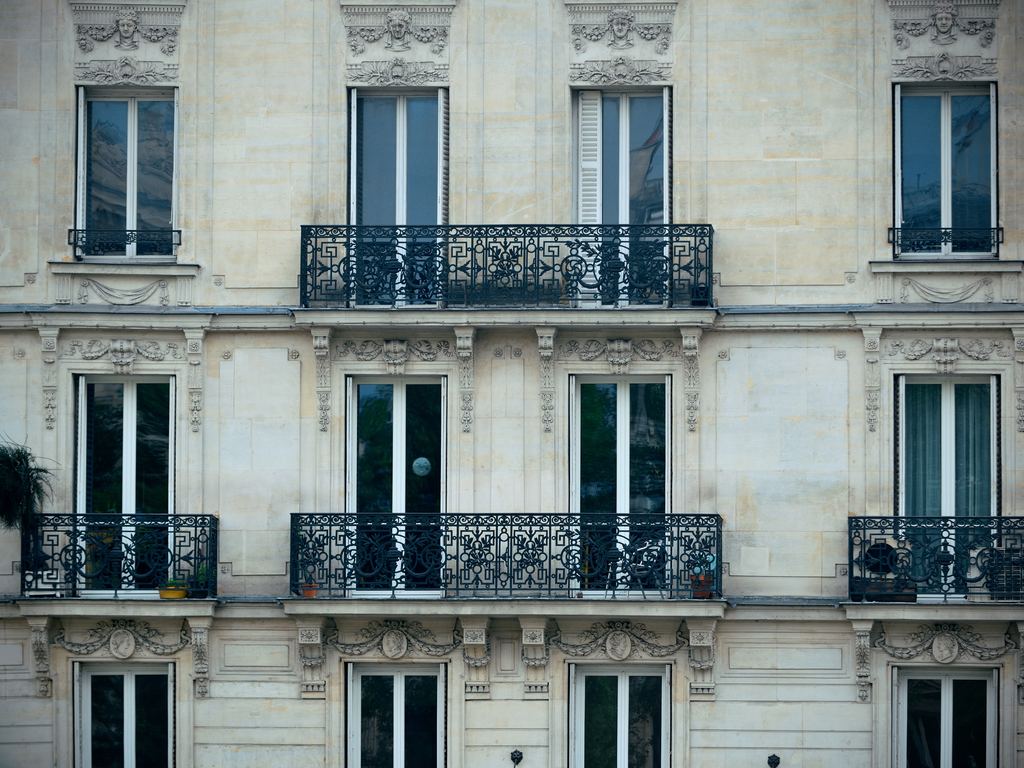
Is the 7th arrondissement the right choice?
If your trip revolves around Orsay, the Louvre, and the Eiffel Tower, the 7th arrondissement is the most direct base. The museum is located within the arrondissement, the Bon Marché is approximately 1,400 meters (19 minutes) away, and the National Assembly is approximately 900 meters away. The RER C connects Orsay to Invalides and Champ de Mars–Tour Eiffel without any changes. The downside: it's a district of ministries and residential areas, so you can expect less nightlife (an unquantified impression). The rue Cler, with its food shops, is approximately 2,200 meters away, about half an hour: if you're staying there, factor in the RER or the bus.
Why is Saint-Germain-des-Prés a good choice for a first-time visit?
Saint-Germain-des-Prés is 1.1 km: fifteen minutes to the cafes, sixteen to the church. You can walk back after an evening out, and you can walk to the museum, without relying on a bus schedule. It's easy to get around: Deyrolle is 8 minutes away, and the booksellers on Quai Voltaire are 4 minutes away. The line 12 stops at Rue du Bac and Sèvres-Babylone, which allows you to reach Solférino in a few stops. The downside: the most famous historical cafes are also the most crowded, and their prices are those of a tourist area, which we won't quantify. See where to eat near the Musée d'Orsay.
Should I stay in the 1st arrondissement to be close to both the Louvre and the Musée d'Orsay?
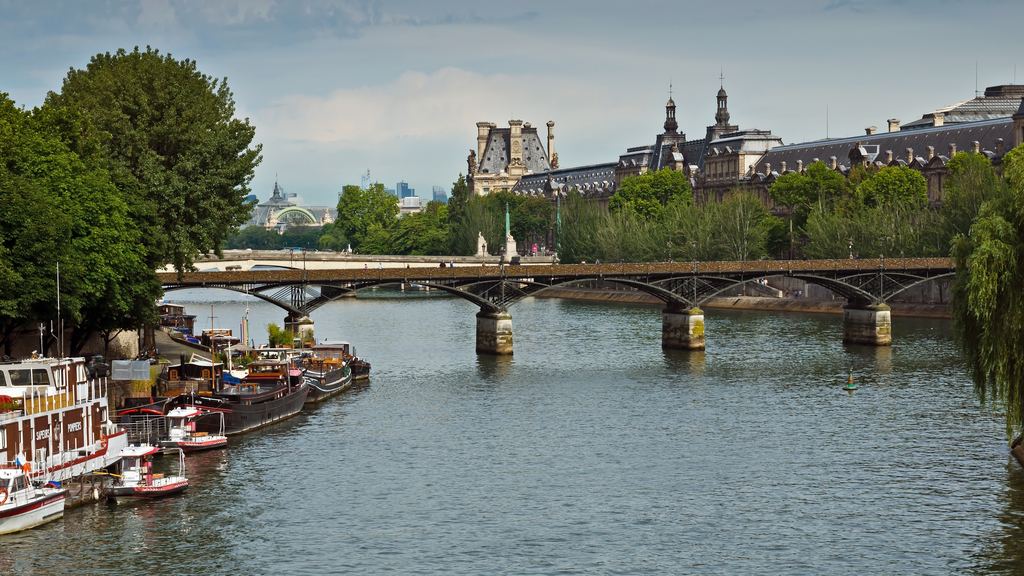
The 1st arrondissement is on the other side of the Seine. From the entrance to the Musée d'Orsay, the Tuileries Garden is about 750 m (ten minutes) away, and Place Vendôme is about seventeen minutes away. The two banks are connected by the Léopold-Sédar-Senghor bridge or the Pont Royal, and by line 12 from Concorde. For those who have purchased a combined ticket for the Musée d'Orsay and the Louvre, this is the most logical starting point; the exact distances between the museums are on the combined ticket page.
Latin Quarter, Marais, train stations: when should you choose them?
The Latin Quarter (5th arrondissement) is 2.4 km away: the Panthéon is approximately 2,400 meters (32 minutes), Sainte-Chapelle is approximately 1,700 meters, and the square in front of Notre-Dame is approximately 1,900 meters. The RER C line passes through Saint-Michel–Notre-Dame and Austerlitz station: this is the direct route to the museum. The Marais (4th arrondissement) is approximately 3,300 meters from the Place des Vosges, a 44-minute walk. We have not confirmed a direct route: use the Île-de-France Mobilités route planner rather than relying on a map.
For train stations, the situation is uneven. Saint-Lazare (approximately 2,600 meters, 35 minutes walking) and Montparnasse (approximately 2,800 meters, 37 minutes) are both on the line 12, so no change is needed to reach Solférino. The station of Austerlitz (approximately 3,900 meters, 52 minutes) is on the RER C. The Gare du Nord (approximately 3,800 meters, 51 minutes) and the Gare de Lyon (approximately 4,300 meters, 58 minutes) require a transfer, which we have not detailed. These stations are suitable for a late arrival or an early departure; they are not ideal for leisurely strolls.
Why don't we mention any hotels?
Because choosing accommodation depends on dates, availability, and prices that change every week, and a guide that lists an address becomes inaccurate as soon as it closes or changes its name. You will find price comparison tools online; this page is designed to help you determine which neighborhood will save you transportation costs. Once you have the neighborhood, compare offers on the platforms of your choice, and look at two things on the map: the distance to line 12 or the RER C, and the presence of a shop that is open late.
What do you need to know about the tourist tax?
According to the service-public.fr page, reviewed for this guide (the last verification date displayed on the page is June 2, 2021), the tourist tax is due per person, per night by the tourist staying in a tourist hotel, a furnished tourist accommodation, a bed and breakfast, or a private rental. It is paid to the accommodation provider or the booking platform, who then remits it to the municipality. The amount varies depending on the type of accommodation and its rating; it is set by the municipality and must be displayed at the accommodation and included on the invoice. Children under 18 years old are exempt, as are those with a seasonal work contract in the municipality. We do not provide any rates.
Is Paris safe? Advice from the Ministry of the Interior
The Ministry of the Interior has published a brochure entitled "Paris: Safe and Secure." It states that police action makes Paris a very safe place, but that visitors may be targeted by pickpockets or scammers in public areas. Its recommendations, summarized: prefer a small bag worn across the body or a fanny pack over a backpack, and keep the opening facing inwards; do not keep your wallet in your back pockets; and do not resist if someone tries to snatch your bag. It also warns about fake police officers and the "petitions" presented near tourist sites.
A real police officer will never ask you for money.
We have not found any recent statistics specific to the 7th arrondissement or the museum; therefore, we do not provide any, and we do not state that one neighborhood is safer than another. For information about bags, please also see the visitor guidelines regarding baggage.
| Your trip | Most logical base | Why |
|---|---|---|
| A few days, with a visit to the Musée d'Orsay on the agenda | 7th arrondissement or Saint-Germain-des-Prés | Exploring Orsay on foot, without transfers |
| Visiting both the Musée d'Orsay and the Louvre in the same day | 1st | Senghor Bridge or Royal Bridge, connecting the two banks |
| Long-term, student life | Latin Quarter | RER C line to Orsay |
| Evenings, small museums | Marais | Further away from Orsay; please allow for a connection |
| Late arrival or early departure by train | Near Saint-Lazare station or near Montparnasse | Line 12 to Solférino |
| Accessible visit | Near Orsay station | Please review the accessibility page before making your selection |
Frequently Asked Questions about Choosing a Neighborhood
Which district is best for accommodation if you want to visit the Musée d'Orsay?
For those arriving on foot, the 7th or 6th arrondissements (Saint-Germain-des-Prés) are ideal. The 1st arrondissement is a good option if you want to visit both the Louvre and the Musée d'Orsay. Other districts require a change of transportation.
Is it better to stay in Saint-Germain or the 7th arrondissement?
Saint-Germain offers a mix of cafes and bookstores, located just fifteen minutes from the museum; the 7th arrondissement is quieter. Both are within a 20-minute walk of the measured points.
Is it possible to stay near a train station and still visit the Musée d'Orsay?
Yes: Saint-Lazare and Montparnasse are on line 12, which serves the Solférino station, located near the museum.
Which metro line goes to the Musée d'Orsay?
Line 12, Solférino station, and RER C, Musée d'Orsay station. Please check the service details on ratp.fr.
Is the tourist tax payable?
It is a per-person, per-night tax levied on stays in tourist accommodations, paid to the accommodation provider or the platform, and its rate is set by the municipality. Children under the age of 18 are exempt.
Is it possible to walk to the Musée d'Orsay from the Marais district?
The Place des Vosges is approximately 3.3 km away, which is a 44-minute walk. Most travelers prefer to take public transportation.
Is Paris dangerous for tourists?
The Ministry of the Interior states that Paris is a very safe city, but that visitors may be targeted by pickpockets: keep your small bag across your body and keep your wallet out of your back pocket.
Do you want me to list some hotels?
No. Addresses and prices change too quickly for a guide; instead, we compare neighborhoods.
Next
Walking distance to the neighborhood, meals included, and access to the museum.
Walkable neighborhood
Distances calculated to the Legion of Honor, the Tuileries Garden, and Saint-Germain-des-Prés.
Where to eat
The museum's locations and historical houses.
Visit the museum
RER C line, metro line 12, buses, and access points during the construction work.
Accessibility
Accessibility features: mobility assistance, scenic views, and audio guides.
Data verified on . Connections are based on information from the museum's website; distances were calculated using OpenStreetMap; the tourist tax information is from service-public.fr; and safety information is provided by the Ministry of the Interior. Politique éditoriale