
This directory brings together 68 works from the Musée d'Orsay. For each: the title as written in the Joconde database entry, the artist, the date, the technique, the inventory number, and how the work entered the public collections (bequest, donation, purchase, transfer, subscription). We do not provide room or level information: the works change location, and the same work may be on loan, in storage, or, if it is a fragile pastel, absent from the walls. Before coming to see a specific painting, please check its location on the museum's website. dorsay.museum is an independent website: it is neither affiliated with nor authorized by the Musée d'Orsay or its public institution, and it features tickets and tours from third-party providers.
How to read an inventory number and a product description
An inventory number is the identifier of a work within the state's inventory. It is sufficient to find it within the POP platform, which hosts the Joconde database, the collective catalog of the collections of French museums maintained by the Ministry of Culture, and in most publications. The following table explains the abbreviations and technical terms that are encountered in the records. An example of each is provided from the directory, when available.
| What you are reading | What that means | Example |
|---|---|---|
| RF with ID number | Series of inventory numbers for national museums, "French Republic." The number follows the order of registration, not the date of acquisition: the Caillebotte donation (1894) has numbers ranging from RF 2700 to RF 2800, while "The Angelus," acquired in 1909, has the number RF 1877. | Olympia: RF 644 |
| RF, year, rank | More recent series: the year precedes the number (RF 1975 19 is the 19th item in the 1975 series). The year indicates the year of registration, which is not always the year of the donation. | Starry Night: RF 1975 19. The Arlésienne, donated in 1944: RF 1952 6 |
| LUX | The second section refers to the Musée du Luxembourg, where some of the works were initially exhibited. | The Bronze Age: RF 676; LUX 91 |
| INVITE | Historical series documenting the Louvre Museum's collection. | "Decline of the Romans": Inventory number 3451 |
| OAO | This is a distinct collection, comprising the works of art housed at the Musée d'Orsay. The majority of the paintings and sculptures in the collection are part of the French national collection ("Réunion des Musées Nationaux" - RF). | OVRI: OAO 1114 |
| MNR | "National Museums: Recovered Works": This refers to artworks recovered after 1945, which were looted during the Occupation and are listed in a separate inventory, eligible for return to their rightful owners. No works in this collection fall under this category. | None |
| Legs | Inheritance through a will. The year of acquisition is the year in which the state formally accepts the inheritance. | "Legs" by Caillebotte, 1894; "Legs" by Camondo, 1911 |
| Manual donation | The gift is transferred directly, without a notarized document. The donation is made while the donor is still alive. | Woman with a Parasol by Monet: Don Manuel, 1927 |
| Donation subject to a right of usufruct | The donor retains ownership of the artwork until the end of the usufruct period: the year of acquisition and the actual transfer of possession are separated. | "The Starry Night": Acquired in 1975, it has been at the Musée d'Orsay since 1995 |
| Donation | Artwork accepted by the state as payment of inheritance taxes. | The Origin of the World, 1995 |
| Purchase upon order, Art acquisition service for living artists | Acquisition of the artist's work by the state, often at exhibitions like the Salon. | Carpeaux's Dance: 1869 |
| Transfer | Specific entry method for a particular case. | Van Gogh's room in Arles, Vairumati: 1959, "application of the peace treaty with Japan." |
| Public offering | Public collection to acquire a work of art. | Olympia: 1889-1890 |
| Hardware input, assignment | The physical transfer refers to the actual arrival of the artwork, which often occurs long after its acquisition. The allocation process assigns an artwork that already belongs to the state to a specific museum. | Olympia: Assigned to the Musée d'Orsay in 1986 |
A description can also be wrong or incomplete. For Monet's Women in the Garden, the database gives 25.5 × 20.5 cm, while the history of the painting, its exchange with Frédéric Bazille's father for a portrait of his son by Renoir, indicates the larger format of 1866: the unit is probably incorrect, and we have omitted the dimensions. For Cézanne's Mont Sainte-Victoire and for Gauguin's Oviri, we were unable to find a description: their inventory comes from Wikidata and Wikipedia, and we write "method of entry not specified" rather than inventing one.
From Realism to Manet: The Salon, the Rejects, and the Subscription
| Artwork | Artist | Date | Technique | Inventory | Acquisition by public collections |
|---|---|---|---|---|---|
| A funeral in Ornans | Gustave Courbet | 1849-1850 | Oil on canvas | RF 325 | Don, 1881 |
| The painter's studio. A real allegory | Gustave Courbet | 1855 | Oil on canvas | RF 2257 | Purchase with public contribution, 1920 (through public subscription and the Société des Amis du Louvre) |
| The injured man | Gustave Courbet | between 1844 and 1854 | Oil on canvas | RF 338 | Acquired at a public auction, 1881 |
| Origin of the world | Gustave Courbet | 1866 | Oil on canvas | RF 1995 10 | Donation, 1995 |
| "The Gleaners" or "The Gleaning Women." | Jean-François Millet | 1857 | Oil on canvas | RF 592 | Donation subject to a right of usufruct; physical acquisition in 1890 |
| The Angelus | Jean-François Millet | 1857-1859 | Oil on canvas | RF 1877 | Legs, 1909 |
| Arrangement in gray and black No. 1; or, The Artist's Mother | James Abbott McNeill Whistler | 1871 | Oil on canvas | RF 699 | Purchase by the Purchasing Department from living artists, 1891 |
| Olympia | Édouard Manet | 1863 | Oil on canvas | RF 644 | Public offering, 1890 |
| "Luncheon on the Grass"; formerly known as "The Bath." | Édouard Manet | 1863 | Oil on canvas | RF 1668 | Donation, 1906 |
| The balcony | Édouard Manet | circa 1868-1869 | Oil on canvas | RF 2772 | Legs, 1894; physical arrival, 1896 |
| The piccolo | Édouard Manet | 1866 | Oil on canvas | RF 1992 | Legs, 1911 |
| Émile Zola | Édouard Manet | circa 1868 | Oil on canvas | RF 2205 | Donation subject to a usufructuary right, 1918; physical acquisition, 1925 |
Olympia, in itself, tells the story of the state's caution. Painted in 1863 and exhibited at the 1865 Salon, it was sold with Manet's studio in 1884, and then repurchased by his widow. In 1889, Claude Monet launched a public subscription to offer it to the state: the widow asked for 20,000 francs, and the painting was purchased for 19,415 francs in March 1890 (Wikipedia). It entered the Luxembourg Museum, where it remained from 1890 to 1907, then moved to the Louvre, the Jeu de Paume in 1947, and Orsay in 1986. The inscription simply says: "Donated through a public subscription initiated by Claude Monet."
Le déjeuner sur l’herbe, in its description, bears the note "formerly known as Le bain." Rejected by the jury of the 1863 Salon, it was exhibited under this first title at the Salon des Refusés, which opened on May 15, 1863. Manet kept it in his studio (1878), then it passed to the collector Jean-Baptiste Faure, to the Durand-Ruel gallery (1898), and into the collection of Étienne Moreau-Nélaton, who donated it in 1906. The same donation, in the same year, brought in Les coquelicots by Monet (RF 1676), whose last stop before the state was also with Moreau-Nélaton.
L'Origine du monde has one of the most detailed provenance records in the database: Khalil-Bey collection, La Narde gallery, Bernheim-Jeune gallery, collection of Baron François de Hatvany, private collection, and then, from 1955, the collection of Jacques Lacan, until 1995. In 1995, the state accepted it as a donation in payment of inheritance taxes (decree of June 13, 1995) and assigned it to the Musée d'Orsay. According to Wikipedia, Lacan had it hidden behind a panel painted by his brother-in-law, André Masson.
The Mother of Whistler is the commonly used title. The title on the label is Arrangement in Grey and Black No. 1; or The Mother of the Artist: the painting was purchased in 1891 by the Department for the Purchase of Works by Living Artists, during the artist's lifetime.
The painters who were honored by the Salon
| Artwork | Artist | Date | Technique | Inventory | Acquisition by public collections |
|---|---|---|---|---|---|
| Decline of the Romans | Thomas Couture | 1847 | Oil on canvas | INV 3451 | Purchase after order, 1847 |
| Birth of Venus | Alexandre Cabanel | circa 1863 | Oil on canvas | RF 273 | Acquired by Napoleon III in 1863; transferred to the national museums by court decision in 1879 |
| The source | Jean-Auguste-Dominique Ingres | Between 1820 and 1856 | Oil on canvas | RF 219 | Legs, 1878 |
The Birth of Venus by Cabanel did not enter through the usual door. Acquired by Napoleon III at the 1863 Salon from the sovereign's civil list, it was, according to the description, "assigned to the national museums by judicial decision" in 1879. As for Thomas Couture's Romans of the Decadence (purchased on commission in 1847, INV 3451) and Courbet's A Burial at Ornans (gift of 1881, RF 325), their display together in the main nave at the 1986 opening is described in the file on the eight Impressionist exhibitions.
Monet, Renoir, Degas: three significant contributions, one donation, and a few acquisitions
| Artwork | Artist | Date | Technique | Inventory | Acquisition by public collections |
|---|---|---|---|---|---|
| Poppies | Claude Monet | 1873 | Oil on canvas | RF 1676 | Donation, 1906 |
| Saint Lazare station | Claude Monet | 1877 | Oil on canvas | RF 2775 | Legs, 1894; physical arrival, 1896 |
| Regattas in Argenteuil | Claude Monet | circa 1872 | Oil on canvas | RF 2778 | Legs, 1894; physical arrival, 1896 |
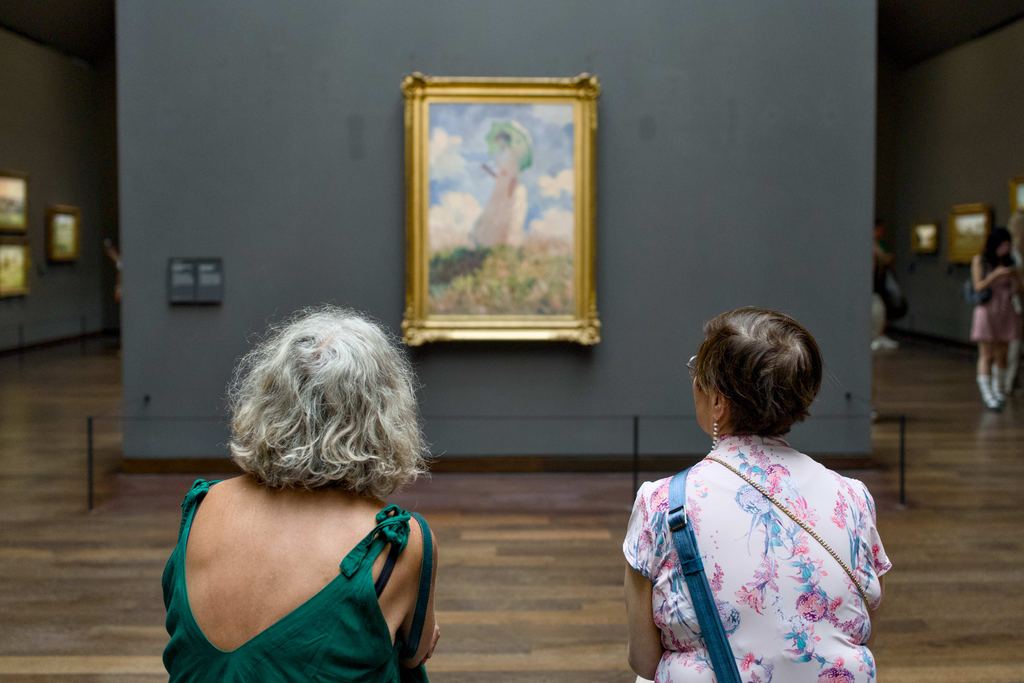
| Outdoor sketch: Woman with an umbrella, turned to the right | Claude Monet | 1886 | Oil on canvas | RF 2620 | User manual, 1927 |
| The Rouen Cathedral; the portal, in a gray light; a gray harmony | Claude Monet | 1892 | Oil on canvas | RF 1999 | Legs, 1911 |
| The Rouen Cathedral; the facade viewed head-on; a harmonious brown aesthetic | Claude Monet | 1892 | Oil on canvas | RF 2779 | Purchase, 1907 |
| Blue water lilies | Claude Monet | The date is not specified in the description | Oil on canvas | RF 1981 40 | Purchase, 1981 |
| The lily pond; a green harmony | Claude Monet | 1899 | Oil on canvas | RF 2004 | Legs, 1911 |
| The Moulin de la Galette | Auguste Renoir | 1876 | Oil on canvas | RF 2739 | Legs, 1894; physical arrival, 1896 |
| The swing | Auguste Renoir | 1876 | Oil on canvas | RF 2738 | Legs, 1894; physical arrival, 1896 |
| Young girls at the piano | Auguste Renoir | 1892 | Oil on canvas | RF 755 | Purchase after order, 1892 |
| City dance | Auguste Renoir | 1883 | Oil on canvas | RF 1978 13 | Donation, 1978 |
| Mrs. Georges Charpentier | Auguste Renoir | circa 1876-1877 | Oil on canvas | RF 2244 | User manual, 1919 |
| In a café, also known as "The Absinthe." | Edgar Degas | circa 1875-1876 | Oil on canvas | RF 1984 | Legs, 1911 |
| Dance class | Edgar Degas | circa 1871-1874 | Oil on canvas | RF 1976 | Legs, 1911 |
| Rehearsal of a ballet on stage | Edgar Degas | 1874 | Oil on canvas | RF 1978 | Legs, 1911 |
| The tube | Edgar Degas | 1886 | Pastel on cardboard | RF 4046 (front) | Legs, 1911 |
| "Fourteen-year-old dancer" or "Dancer in a large costume." | Edgar Degas | Wax dated no later than 1881; bronze cast between 1921 and 1931 | Bronze, cast using the lost-wax method | RF 2137 | Acquisition: 1930; Physical accession: 1931 |
| Family portrait, also known as "The Bellelli Family." | Edgar Degas | circa 1858-1867 | Oil on canvas | RF 2210 | Public auction with bidding, 1918 |
I am donating the paintings I own to the state; however, I want this donation to be accepted in such a way that these paintings are not relegated to an attic or a provincial museum, but rather end up in Luxembourg and, later, in the Louvre...
The Caillebotte bequest is the gateway through which the Impressionists entered state museums. Gustave Caillebotte died on February 21, 1894, leaving his collection to the state, with the condition mentioned above: the paintings would go to the Luxembourg Museum and then to the Louvre, neither to an attic nor to a provincial museum. The administration did not accept everything, and the figures for the bequest vary according to the sources: 65, 67, or 70 works were offered. Therefore, we write that approximately forty works were accepted out of sixty to seventy offered, without a more precise figure. The stages of the bequest, the protests of the Academy, and the transfer of 1896 are detailed in the dossier on the eight Impressionist exhibitions.
The records allow us to trace the artwork's journey: acquisition in 1894, physical arrival in 1896, assignment to the Louvre in 1929, and then to Orsay in 1986, with an intermediate stop at the Jeu de Paume starting in 1947 (Wikipedia). Six paintings from the collection are featured: The Balcony, The Gare Saint-Lazare, Regattas at Argenteuil, The Moulin de la Galette, The Swing, and The Red Roofs. There is an error: The Floor Scrapers is not part of the bequest. The record mentions a donation from the heirs of Caillebotte and Renoir, which was accepted in addition.
The Camondo donation of 1911 is another significant moment. Count Isaac de Camondo bequeathed to the State a collection, and the records indicate: fifteen out of the 99 records we examined mention "donation, 1911" with Camondo listed in the provenance, including four out of the five Rouen Cathedrals (RF 1999 to 2002), Cézanne's The Card Players, several Degas paintings, Lautrec's The Clown Cha-U-Kao, and Sisley's The Flood at Port-Marly. The fifth Cathedral (RF 2779, the portal seen from the front; brown harmony) was an acquisition from 1907. For The Bather, a pastel, the record cites a note from Camondo's notebook: "The woman in the bather, Boussod – April 1895 – 16,000 francs." As with all pastels, it is fragile and comes from the Department of Prints and Drawings at the Louvre: its presence in the exhibition is not guaranteed.
The collection of Alfred Chauchard, in 1909, included L'Angélus by Millet, whose provenance goes back to a sale by the American Art Association in 1890, before Chauchard. As for the Little Dancer of Fourteen Years, what the Musée d'Orsay possesses is a bronze cast by Hébrard, purchased in 1930 and acquired in 1931 "thanks to the generosity of the artist's heirs and the Hébrards"; the original wax model is at the National Gallery of Art in Washington.
| Artwork | Artist | Date | Technique | Inventory | Acquisition by public collections |
|---|---|---|---|---|---|
| The crib | Berthe Morisot | 1872 | Oil on canvas | RF 2849 | Purchase, 1930 |
| Family gathering | Frédéric Bazille | 1867 | Oil on canvas | RF 2749 | Acquisition through contribution, 1905; physical acquisition, 1929 |
| Floor sanders | Gustave Caillebotte | 1875 | Oil on canvas | RF 2718 | Donation from the Caillebotte and Renoir heirs, 1894; acquisition, 1896 |
| Roofs under snow | Gustave Caillebotte | 1878 | Oil on canvas | RF 876 | Don Manuel, 1894; physical acquisition: 1929 |
| The flooding in Port-Marly | Alfred Sisley | 1876 | Oil on canvas | RF 2020 | Legs, 1911 |
| Red rooftops. A village corner, with a wintery feel | Camille Pissarro | 1877 | Oil on canvas | RF 2735 | Legs, 1894; physical arrival, 1896 |
Van Gogh, Cézanne, Gauguin: These artists achieved recognition later in their careers
| Artwork | Artist | Date | Technique | Inventory | Acquisition by public collections |
|---|---|---|---|---|---|
| Starry night | Vincent van Gogh | 1888 | Oil on canvas | RF 1975 19 | Donation with usufructuary rights, 1975; has been at the Musée d'Orsay since 1995 |
| Van Gogh's room in Arles | Vincent van Gogh | 1889 | Oil on canvas | RF 1959 2 | Cession (peace treaty with Japan), 1959 |
| The church in Auvers-sur-Oise | Vincent van Gogh | 1890 | Oil on canvas | RF 1951 42 | Participatory purchase, 1951 |
| The Arlesienne | Vincent van Gogh | 1888 | Oil on canvas | RF 1952 6 | Donation subject to a right of usufruct, 1944; physical acquisition, 1974 |
| The dance studio in Arles | Vincent van Gogh | 1888 | Oil on canvas | RF 1950 9 | Donation subject to a right of usufruct, 1950; acquisition through physical transfer, 1975 |
| Card players | Paul Cézanne | circa 1890-1895 | Oil on canvas | RF 1969 | Legs, 1911 |
| The hanged man's house | Paul Cézanne | 1873 | Oil on canvas | RF 1970 | Legs, 1911 |
| A modern Olympia | Paul Cézanne | circa 1873 | Oil on canvas | RF 1951 31 | User manual, 1951 |
| Mount Sainte-Victoire | Paul Cézanne | circa 1890 | Oil on canvas | RF 1969 30 | Unspecified input mode |
| Joyfulness | Paul Gauguin | 1892 | Oil on canvas | RF 1961 6 | Legs, 1961 |
| The lovely Angèle | Paul Gauguin | 1889 | Oil on canvas | RF 2617 | User manual, 1927 |
| Inventory | Paul Gauguin | 1897 | Oil on canvas | RF 1959 5 | Cession (peace treaty with Japan), 1959 |
| And the gold of their bodies | Paul Gauguin | 1901 | Oil on canvas | RF 1944 2 | Purchase, 1944 |
| Overview | Paul Gauguin | 1894 | Sandstone | OAO 1114 | Unspecified input mode |
| The circus | Georges Seurat | 1891 | Oil on canvas | RF 2511 | Legs, 1924; physical entry, 1927 |
| The clown Cha-U-Kao | Henri de Toulouse-Lautrec | 1895 | Oil on cardboard | RF 2027 | Legs, 1911 |
| Bathroom | Henri de Toulouse-Lautrec | 1896 | Oil on cardboard | RF 2242 | Legs, 1914 |
| Dancing at the Moulin Rouge | Henri de Toulouse-Lautrec | 1895 | Oil on canvas | RF 2826 A | Manual purchase and donation, 1929 |
The Starry Night at the Musée d'Orsay is the painting from Arles, painted in 1888 (73 × 92 cm according to the museum). It is not The Starry Night, which dates from 1889 and is located at the MoMA in New York. Its record on the museum's website details its provenance: Theo van Gogh in 1889, his sister-in-law Jo van Gogh-Bonger until 1905, the collector Bas Veth from 1905 to 1922, a sale in Amsterdam on June 20, 1922, the Buffa gallery, Fernand Moch around 1930, and then Marguerite and Robert Kahn-Sriber. In 1975, the state accepted the donation from the Kahn-Sriber couple "subject to usufruct," in memory of the Moch couple (decree of October 7, 1975). The work is attributed to the Louvre, but it only arrived at Orsay in 1995, at the end of the usufruct period. It was exhibited at the Salon des Indépendants in 1889 under number 272.
The Starry Night and Arearea will be lent to the Tokyo Metropolitan Art Museum from November 14, 2026, to March 28, 2027; the date of their return to display has not been announced.
The same logic applies to The Arlésienne and The Dance Hall at Arles, which were donated with usufruct in 1944 and 1950: they only arrived at the museum in 1974 and 1975, thirty and twenty-five years later. Two other works arrived in 1959 through "cession": Van Gogh's Bedroom at Arles and Gauguin's Vairumati, "in application of the peace treaty with Japan" (according to the records). Both had previously belonged to Prince Kojiro Matsukata. Van Gogh painted three versions of his bedroom; the one at the Musée d'Orsay is the third, from 1889.
At the Seurat museum, The Circus was first owned by Paul Signac, then by the American John Quinn, before being acquired in 1924 through a bequest; the frame was painted by the artist. At the Lautrec museum, The Dance at the Moulin Rouge was a decorative panel for La Goulue's booth in 1895, purchased as eight separate panels and reassembled in 1930.
Symbolists, Nabis, and Naïve artists
| Artwork | Artist | Date | Technique | Inventory | Acquisition by public collections |
|---|---|---|---|---|---|
| Orpheus | Gustave Moreau | 1865 | Oil on wood | RF 104 | Purchase by the Purchasing Department from living artists, 1866 |
| The poor fisherman | Pierre Puvis de Chavannes | 1881 | Oil on canvas | RF 506 | Purchase, 1887 |
| Tribute to Cézanne | Maurice Denis | 1900 | Oil on canvas | RF 1977 137; LUX 048 P | User manual, 1928 |
| Snake charmer | Henri Rousseau, also known as "Le Douanier" (The Customs Officer) | 1907 | Oil on canvas | RF 1937 7 | Legs, 1925; physical entry, 1935 |
| The War or The Ride of Discord | Henri Rousseau, also known as "Le Douanier" (The Customs Officer) | 1893-1894 | Oil on canvas | RF 1946 1 | Purchase, 1946 |
The Snake Charmer by Douanier Rousseau has a story of promises. Robert and Sonia Delaunay sold it for 50,000 francs to the fashion designer Jacques Doucet, through the intermediary of André Breton, on the condition that he would bequeath it to the Louvre. The record indicates the acquisition in 1925 and the actual entry into the collection in 1935: after Doucet's death in 1929, his widow requested to keep the work in her possession.
Some sculptures
| Artwork | Artist | Date | Technique | Inventory | Acquisition by public collections |
|---|---|---|---|---|---|
| Dance | Jean-Baptiste Carpeaux | between 1865 and 1869 | High-relief sculpture | RF 2884 | Purchase after order, 1869 |
| The Bronze Age | Auguste Rodin | between 1875 and 1876 | Bronze, black patina | RF 676; LUX 91 | Purchase at the Fair, 1880 |
| Rhino | Henri-Alfred Jacquemart | 1878 | Font | RF 3753 | Purchase after order, 1878 |
| Young elephant trapped | Emmanuel Frémiet | 1878 | Font, alloy | RF 3752 | Purchase after order, 1878 |
| Polar bear | François Pompon | 1925 | Peter | RF 3269 | Purchase, 1926 |
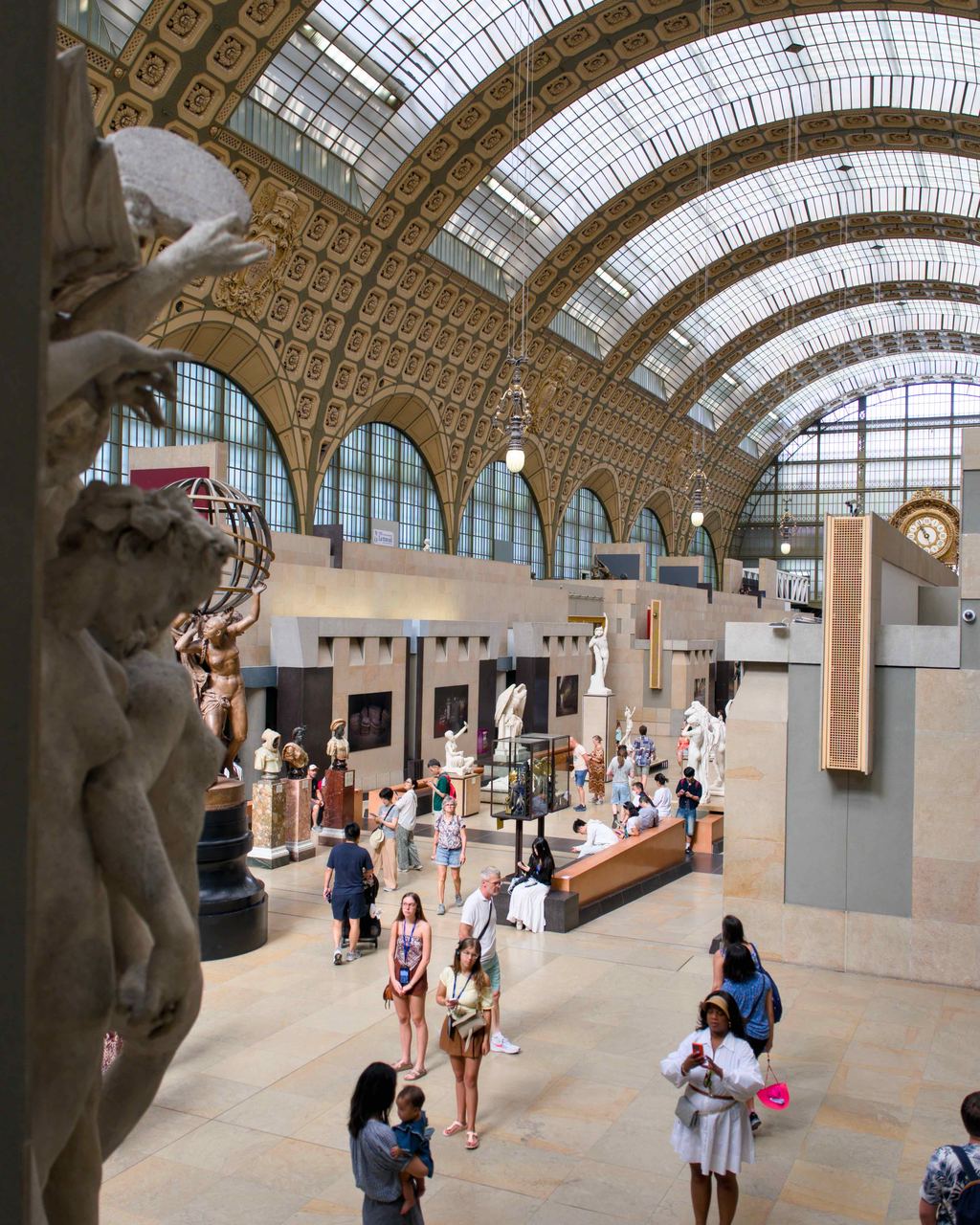
The Dance by Carpeaux, a high-relief sculpture commissioned for the facade of the new Paris Opera, was acquired in 1869. The Rhinoceros by Jacquemart and The Young Elephant Trapped by Frémiet are two castings from the 1878 World's Fair, purchased after being commissioned the same year. However, a work listed in the Orsay inventory is not necessarily located at Orsay: for the elephant, the record indicates its location at the Saint-Cloud gate after 1935, and then at the Coubertin Foundation in Saint-Rémy-lès-Chevreuse in 1986; Wikipedia lists it with The Rhinoceros in front of the museum, and the two sources do not agree.
When were these works acquired?
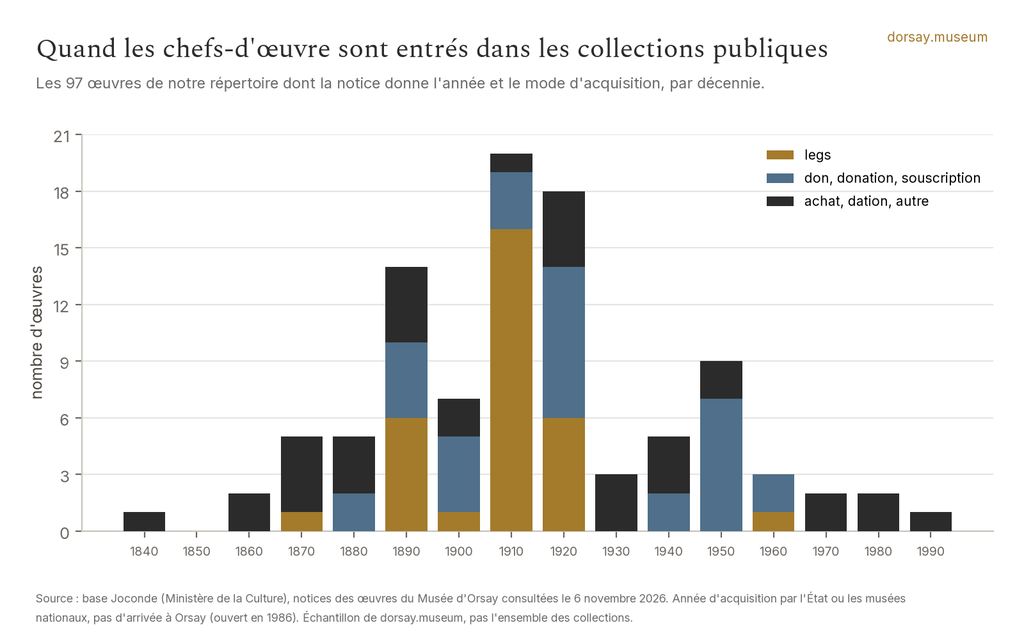
Of the 97 works in our database for which the record indicates a year of acquisition, 33 are purchases, 31 are bequests, and 31 are donations (manual donation, donation, gift); two other acquisitions are atypical: the subscription of Olympia and the seizure of The Birth of Venus. More than a third (38) were acquired between 1910 and 1929, and 14 in the 1890s, which refers to the two major bequests, Caillebotte (1894) and Camondo (1911), for 9 and 15 works in our database (the nine from 1894 include two donations from the family and from Renoir, in addition to the bequests). This is our selection of masterpieces, not a representative sample of the museum, and the year of acquisition, not the actual date of arrival.
A work of art may be on loan, in storage, or not currently on display
An inventory number does not indicate where the artwork is located on the day of your visit. Of the 5,412 works of art in the museum's collection, housed in nearly 450 different locations outside of the Louvre, approximately 1,670 paintings are in provincial museums, public buildings, or abroad, according to Wikipedia. Pastels and works on paper are not always on display. As for the exhibitions, they change regularly. If a specific artwork is the reason for your visit, check its page on the museum's website before you come, and do not rely on a room mentioned in a guide.
The Starry Night, The Gleaners, and Arearea will be lent to the Tokyo Metropolitan Art Museum from November 14, 2026, to March 28, 2027; the date of their return to display has not been announced.
The artworks that people are looking for at the Musée d'Orsay, but which are not there
| Sometimes, this is what you read | That's correct |
|---|---|
| Impression, Sunrise is at the Musée d'Orsay | It is located at the Musée Marmottan Monet. |
| The Water Lilies are at the Musée d'Orsay | The main collection is located at the Musée de l'Orangerie, which was bequeathed to the state by Monet. The Musée d'Orsay houses "Water Lilies in Blue" (RF 1981 40) and "The Water Lily Pond; Green Harmony" (RF 2004). |
| The starry night at the Musée d'Orsay is called "The Starry Night." | No, the painting at the Musée d'Orsay is the "Arles" painting from 1888; "The Starry Night," from 1889, is at the MoMA. |
| "A Sunday Afternoon on the Island of La Grande Jatte" is at the Musée d'Orsay | It is located at the Art Institute of Chicago. The Musée d'Orsay has Seurat's "The Circus" (RF 2511). |
| "Paris Street, Rainy Day" by Caillebotte is currently on display at the Musée d'Orsay | It is located at the Art Institute of Chicago. The "Bridge of Europe" is at the Petit Palais in Geneva. |
| "The Little Dancer of Fourteen Years" is a wax sculpture by Degas | The Musée d'Orsay has the bronze cast of the Hébrard sculpture (RF 2137), while the original wax model is in Washington. |
| "The Card Players" is the painting that was sold for $250 million | No: Orsay has a two-player version (RF 1969). According to Wikipedia, another version was acquired in 2011 by the Qatari royal family. |
| The parquet scrapers are part of the Caillebotte collection | No: Donations from the descendants of Caillebotte and Renoir, accepted in addition to the bequest. |
| The Caillebotte bequest has been rejected | It was initially accepted in principle on March 20, 1894, and then narrowed down to approximately forty works. |
Frequently Asked Questions about the artworks
Where is Van Gogh's "The Starry Night"?
At the Musée d'Orsay, inventory number RF 1975 19, since 1995, except from November 14, 2026, to March 28, 2027: during this period, it will be on loan to the Tokyo Metropolitan Art Museum. We do not provide the room number, as it changes: please consult the museum's website before visiting.
Is the starry night scene at the Musée d'Orsay the same as the one at the MoMA?
No. The painting from Orsay is the "Arles" painting from 1888; The Starry Night, painted in Saint-Rémy in 1889, is at the MoMA in New York.
Can you see the Mona Lisa at the Musée d'Orsay?
No, it is at the Louvre. The Orsay collections begin in 1848, while the Louvre's collections end before that. Don't confuse La Joconde with the Joconde database, which catalogs the collections of French museums.
Where can I see "Le déjeuner sur l'herbe" and "Olympia"?
At the Musée d'Orsay: Le déjeuner sur l'herbe has the inventory number RF 1668 (donation from Moreau-Nélaton, 1906), and Olympia has the inventory number RF 644 (subscription, 1890). Like all artworks, they may be moved or loaned out: please check before visiting.
Are the paintings being moved?
Yes, regularly: artworks are often loaned out, sent for restoration, or placed in storage, and the galleries are rearranged. That's why we don't list any specific gallery numbers.
What does "RF" mean when it appears before an inventory number?
RF stands for "République française" (French Republic), and it is the prefix used in the inventory numbers of national museums. The number that follows identifies the specific artwork. Please refer to the table "How to read an inventory number" for more information.
How can I find the documentation for a work of art from the Musée d'Orsay?
On the POP platform of the Ministry of Culture, pop.culture.gouv.fr, you can search for the title or inventory number in the Joconde database.
Learn more
The eight Impressionist exhibitions
The Caillebotte bequest, within its historical context, and the paintings that were exhibited between 1874 and 1886.
Paris: The City of Paintings
The real-world locations depicted in these artworks, and how to find them.
Artistic movements
Realism, Impressionism, and Nabis: What to look for in a painting.
See these works with a guide
A guided tour follows a specific route within the museum. Information about the different tour options and prices can be found on the guided tours page.
Data verified on . Joconde database (Ministry of Culture), consulted on November 6, 2026; information about "The Starry Night" on the museum's website. "Wikipedia" mentions: secondary source. Politique éditoriale