
What to bring when visiting the Musée d'Orsay? A small bag, a camera or phone, comfortable shoes, and clothing appropriate for the season. Large backpacks, carry-on suitcases, and large umbrellas must be left at the cloakroom, which is free and self-service; any luggage larger than 56 x 45 x 25 cm is not allowed and will not be stored. Flash photography, tripods, and selfie sticks are prohibited. However, you can draw with a pencil in the permanent collections. Each rule refers to its corresponding article in the visitor regulations (Decision 2021-003), which we reviewed on November 6, 2026.
This page discusses what to bring. The entrance through which you enter with luggage is explained on the page about access and entrances. The rest of the regulations, which relate to children and strollers, are covered in the family visit section.
What can you bring to the Musée d'Orsay? (A checklist of items you can bring.)
The chart lists the items that are problematic at the entrance. "Deposit required" means the item must be left in the cloakroom, free of charge. "Refused" means the item is not allowed inside at all. The items listed are those mentioned in the visitor regulations.
| Subject | Admitted? | Why (visitation rules) |
|---|---|---|
| Small handbag, shoulder bag | Yes, after verification | Bags are checked at the entrance (article 13, Vigipirate plan). |
| Large backpack | Mandatory locker room | According to the "Services" section of the museum's website and Article 25, this is a mandatory deposit. |
| Carry-on luggage, up to 56 x 45 x 25 cm | Mandatory locker room | The same applies to suitcases of this size: the museum lists them. |
| Bags larger than 56 x 45 x 25 cm | Rejected | Prohibited from entering (article 15) and excluded from the cloakroom (article 25). |
| Motorcycle or bicycle helmet | Wardrobe | Article 25. |
| Large umbrella | Wardrobe | Article 25: "Large umbrellas and all pointed, sharp, or blunt objects." |
| Compact umbrella | No written rules | The regulation applies to large umbrellas. In case of any doubt, security personnel will make the final decision at the entrance. |
| Scooter, roller skates, skateboard, folding bicycle | Rejected | Article 15. |
| Tools, cutters, screwdrivers, pruning shears | Rejected | Article 15. |
| Camera, phone | Yes | Private use only is permitted (article 60). |
| Flash and auxiliary lighting | Forbidden | Article 61. |
| Tripod, selfie stick | Restricted area, cloakroom | Article 61 ("all types of stands, tripods, or telescopic arms") and Article 25. |
| Notebook and pencil | Yes | Drawing is permitted in the permanent collections (article 59). |
| Ink, fixative | Prohibited | Article 66: "Strictly prohibited." |
| Easel, canvas, and drawing board (larger than 50 x 32.5 cm) | Locker, permission required | Article 25. |
| Bottle | Yes | The museum indicates where you can fill your water bottle. Eating and drinking outside of designated areas remains prohibited (article 36). |
| A large quantity of food or drinks | Rejected | Article 15: "In excessive quantities, as determined by the officers." |
| Animals | Rejected | Article 15, except for guide dogs and assistance animals. |
| Umbrella stroller | Yes | Article 25 excludes umbrella strollers from the mandatory deposit scheme. |
| Landau, bulky stroller, metal-framed baby carrier | No | The museum does not allow them inside the premises (see the "Services" section of the museum website); article 25 requires them to be left at the cloakroom. |
| Binoculars, magnifying glass, telescope | No, unless you have a visual impairment | Article 37. |
| Musical instrument | Wardrobe | Article 25. |
What the cloakroom does not keep (art. 26): tickets, identification documents, means of payment, handbags, fragile or valuable items, including jewelry, cameras, laptops, and phones. Tips are prohibited (art. 24), and the deposit is returned on the same day, before the museum closes (art. 28). If you lose your claim ticket, it is up to you to prove that the item belongs to you (art. 27). Therefore, keep your documents, money, phone, and camera with you.
What size bag is allowed in the Musée d'Orsay? The rule is: bags must not exceed 56 x 45 x 25 cm
Sometimes, this figure is read as the size of the luggage that one can keep with them, or as the size of the suitcase that the museum accepts at the cloakroom. The regulations state otherwise. Article 15 prohibits bringing in luggage with dimensions greater than L 56 × H 45 × D 25, and article 25 excludes these same bags from the cloakroom. This limit therefore gives rise to three cases:
- A petit sac à main or a shoulder bag will remain with you after the security check;
- A sac à dos volumineux large backpack or a piece of luggage up to 56 x 45 x 25 cm will go to the cloakroom, where depositing it is mandatory;
- A larger bag won't fit anywhere: the cloakroom won't take it either.
The size limit of 56 x 45 x 25 cm refers to the size of bags that are not allowed; the museum will not even accept bags larger than this size at the cloakroom.
If you arrive from the train station or airport with a suitcase, leave it at the hotel or in an external luggage storage facility. Private luggage storage facilities have their own rates; these are not the figures specified in the regulations. And with authorized luggage, the Entrée Parvis is the entrance that the museum requests you to use during the construction work.
What shoes should you wear when visiting the Musée d'Orsay?

Shoes that have already been worn, not new ones
The regulation doesn't specify the type of shoes, except that you must wear them: article 14 prohibits visitors from entering with bare feet, and article 35 prohibits taking off your shoes. We found no information from the museum regarding the type of flooring: the following is a suggestion, not a rule.
A visit lasting one to two hours is almost entirely on foot, and benches are scarce (article 35 prohibits lying down on them). Choose shoes that are already worn, with a soft sole. Open sandals are suitable in the summer, provided you remain in decent attire: swimwear, bare torsos, and underwear are not allowed (article 14). To estimate the duration and effort required, see the page on estimated time.
What should I wear when visiting the Musée d'Orsay, depending on the season?
Inside, you are sheltered. The climate in Paris affects the journey, any potential waiting time at the entrance, and the coat you will leave at the cloakroom (free of charge, it accepts "coats and small bags"). The figures below are the 1991-2020 averages from the Paris-Montsouris station, published by Météo-France: these are averages over thirty years, not forecasts or records.
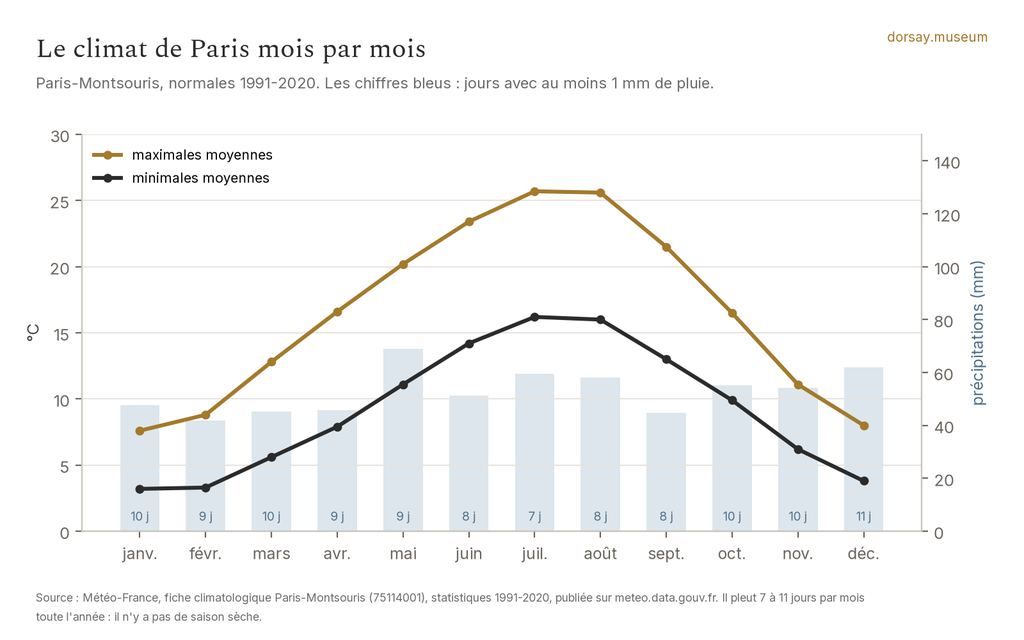
| Month | Maximum average | Minimum average | Rainfall (mm) | Days with rainfall (≥ 1 mm) |
|---|---|---|---|---|
| January | 7.6 °C | 3.2 °C | 47.6 | 9.9 |
| February | 8.8 °C | 3.3 °C | 41.8 | 9.1 |
| March | 12.8 °C | 5.6 °C | 45.2 | 9.5 |
| April | 16.6 °C | 7.9 °C | 45.8 | 8.6 |
| May | 20.2 °C | 11.1 °C | 69.0 | 9.2 |
| June | 23.4 °C | 14.2 °C | 51.3 | 8.3 |
| July | 25.7 °C | 16.2 °C | 59.4 | 7.4 |
| August | 25.6 °C | 16.0 °C | 58.0 | 8.1 |
| September | 21.5 °C | 13.0 °C | 44.7 | 7.5 |
| October | 16.5 °C | 9.9 °C | 55.2 | 9.5 |
| November | 11.1 °C | 6.2 °C | 54.3 | 10.4 |
| December | 8.0 °C | 3.8 °C | 62.0 | 11.4 |
Winter, from December to February
The maximum temperatures peak at 7.6 to 8.8 °C, and the minimum temperatures remain between 3 and 4 °C. On average, there are 7 days of frost in January, 5.3 in February, and 5.4 in December. December is the rainiest month in terms of the number of days, with 11.4 days of at least 1 mm of rainfall, and one of the least sunny months: 57 hours of sunshine, compared to 222 in July. A warm coat, light gloves: the wardrobe covers everything, and you visit wearing a sweater.
Spring, from March to May
It's the season of temperature fluctuations: in April, the average maximum is 16.6 °C and the minimum is 7.9 °C, which is nearly 9 degrees between morning and afternoon. May is the wettest month of the year in terms of accumulated rainfall (69 mm), ahead of December (62 mm), and not autumn, which is often mistakenly thought to be more humid. Light layers, a lightweight waterproof jacket, and a small umbrella.
Summer, from June to August
The average maximum temperatures range from 23.4 to 25.7 °C. In July, 16.7 days reach at least 25 °C, and 5.5 days reach at least 30 °C. These averages are based on a thirty-year period: a heatwave significantly exceeds these values, and the weather from the previous day is what matters. Plan for light but decent clothing, a water bottle to fill at the museum's fountains, a hat for waiting, and remember that Article 20 allows the museum to close rooms in case of excessive crowds.
Autumn, from September to November
September remains mild (21.5 °C maximum), then November drops to 11.1 °C with 10.4 days of rain and only 70 hours of sunshine, compared to 175 in September. October has almost no days at 25 °C (0.6). A waterproof jacket and a compact umbrella are sufficient; the large umbrella, on the other hand, goes to the coat check.
Photos, video, flash, tripod: what can you do with them?
Photographing and filming for strictly private use is permitted in the museum, provided that it does not compromise the integrity of the artworks, does not obstruct the movement or comfort of other visitors (article 60). The museum specifies on its page of visiting conditions that the flash must be turned off, and article 61 prohibits the use of flash, lamps, and any lighting device, as well as "all types of stands, tripods, or telescopic arms": this also applies to the selfie stick, which must be left in the cloakroom.
Two additional restrictions apply. The museum may prohibit photography in front of certain artworks, at the request of their lenders, with a notice displayed at the entrance to the room or near the artwork; in a temporary exhibition, the prohibition may be total and will then be indicated on the label. Furthermore, any photography or filming for professional or commercial purposes is strictly prohibited without authorization (article 62), and filming or photographing a person, employee, or visitor requires their consent (article 64).
The telephone: Article 36 prohibits disturbing the peace through the use of mobile phones. The museum's "Visiting Together" guide requests that you put your phone on silent to preserve the tranquility. Wi-Fi is free and open to everyone (network Musee_Orsay_Public).
Is it allowed to sketch or draw at the Musée d'Orsay?

Yes, in pencil, within the permanent collections
Article 59 states it in a single sentence: you can draw with a pencil (either graphite or colored) on a support that does not exceed 30 × 60 cm, only in the permanent collections. Article 66 adds that freehand sketches can be made without formality, as long as they do not obstruct anyone, and that "the use of ink and fixative is strictly prohibited." Easels, canvases, and boards larger than 50 × 32.5 cm must be left at the coat check, unless authorized. Copying a work requires the authorization of the president of the institution.
The museum lends out folding stools upon presentation of identification, but does not specify whether they can be used for drawing. Drawing is not permitted in the temporary exhibitions (article 59).
Is it allowed to eat and drink at the Musée d'Orsay?
Article 36 prohibits eating or drinking outside of the designated areas for that purpose, and article 15 allows agents to refuse meals and drinks "in excessive quantities." A small water bottle is not a problem: the museum itself indicates water fountains where you can fill your bottle or drink directly, located at level -1 near Lille, at the end of the nave near the Paris area, and at level 1 in the waiting area.
To sit down, the museum offers four locations, accessible with an entrance ticket and without reservation: the Restaurant, the Café Campana, the Café de la Gare, and, depending on the season and weather, the Terrace. Their opening hours vary, and we do not provide them here. As any visit is final, a picnic can be enjoyed before or after the visit: see where to eat at the museum and nearby.
Children, strollers, and walking sticks: special cases
Children under 13 years old must be accompanied by a responsible adult (article 16), and it is forbidden to carry them on shoulders (article 36). Stroller-type prams are allowed; large strollers and bassinets are not. Walking sticks with a tip are allowed throughout the course, and the museum lends wheelchairs and folding seats free of charge upon presentation of identification: all details are provided on the accessibility page.
Here's what you're better off leaving at the hotel:
Here's a list of things that make entry difficult without adding anything positive to the experience:
- the tripod and the selfie stick, which are prohibited in the rooms;
- the large suitcase, which the museum does not keep;
- the cutting objects (cutters, screwdrivers, pruning shears), which are prohibited from entering;
- the scooter, roller skates, the skateboard, and the folding bicycle;
- the large umbrella, which will need to be left;
- The valuable items that you don't need: the cloakroom does not keep them.
To enter with luggage: please use the main entrance area
The museum requests that visitors with luggage use the "Parvis" entrance during the construction work. A map of the entrances is available on the "Access and Entrances" page.
Frequently Asked Questions: Bags, Photos, Coat Check
Is it possible to enter the Musée d'Orsay with a backpack?
Yes, but a large backpack must be left at the cloakroom, which is free of charge and self-service. A small bag can remain with you after the security check.
Where is the cloakroom at the Musée d'Orsay, and is it free to use?
It is free and self-service. It is located on the ground floor, near the reception area, after the security check; the museum's guide map indicates its location.
Is it possible to leave a suitcase at the Musée d'Orsay?
Only if it does not exceed 56 × 45 × 25 cm. Otherwise, it will not be accepted, and the museum will not keep it.
Is it allowed to take photos at the Musée d'Orsay? Is flash photography permitted?
Photos and videos for personal use are permitted in the museum, without flash. Certain artworks or temporary exhibitions may be subject to a ban, which will be indicated on site.
Are selfie sticks and tripods allowed?
No. Article 61 prohibits "all types of stands, tripods, or telescopic poles"; these items must be left at the coat check.
Is it allowed to draw in the rooms?
Yes, using pencil only, on a support no larger than 30 × 60 cm, within the permanent collections. Ink and fixative are prohibited.
Is it allowed to eat or drink inside the museum?
Food and drinks are not allowed outside of designated areas (article 36). The museum has four designated areas where food and drinks are permitted, accessible with an admission ticket, and there are water fountains available for refilling water bottles.
Is it allowed to bring an umbrella inside?
The regulation targets large umbrellas, which are to be left at the coat check. It says nothing about small, folding umbrellas: agents decide at the entrance.
Is it possible to enter with a dog?
No, except for guide dogs and assistance animals (article 15). Dogs in training are also permitted, provided they have the necessary documentation if the museum requests it.
Is there free Wi-Fi available at the Musée d'Orsay?
Yes: the museum indicates that there is a free Wi-Fi network available to everyone, on the network Musee_Orsay_Public.
To continue preparation
Four adjacent pages, each covering a topic that this one does not.
Access, entrances, and hours
RER C line, Metro line 12, Entrance at the platform or esplanade, last access point.
Accessibility
Armchairs available for loan, magnetic loops, sign language, FALC (a type of assistive listening device), blue bag.
With children
Strollers, baby area, activities by age.
When to come
Months, days, and hours: numbers and choices.
Data verified on . Rules reviewed in the visitor regulations (Decision 2021-003) and on musee-orsay.fr on November 6, 2026; climate: Météo-France, averages for the period 1991-2020. Politique éditoriale