

To visit the Musée d'Orsay with fewer crowds, the three choices to make, in order, are the month, the day, and the time. According to the hotel occupancy index from INSEE, January and February are the months when the Île-de-France region experiences the fewest overnight stays. The museum is closed on Mondays; in the attendance grid it published in 2021, only Tuesday and Sunday were classified as "high." On Thursday evenings, it remains open until 9:45 PM. No public figures indicate how many people are in the rooms on a particular day or at a specific time: this page provides what is available and explains what can be inferred.
What is the best time to visit the Musée d'Orsay?
There is no detailed response. The museum publishes the number of visitors per year (3,785,134 in 2025) and nothing more specific: no monthly data, no hourly counts. What we can do is cross-reference three reliable sources: an indirect measure of tourist presence in Paris, a visitor density grid that the museum published in 2021, and the opening hours for November 2026. The conclusions we draw from this are modest, and we present them as such.
If you only remember one rule: avoid combining a month with high tourist activity (June, July, October), a day that the museum classifies as "important" (Tuesday, Sunday), and the middle of the day. Each choice reduces the number of visitors; none guarantees an empty room. For the raw visitor numbers since 2001, see the report on visitor numbers.
Step 1: Which month should you choose?
The matrix below classifies the twelve months according to three criteria. The first two rows provide measurements taken in Paris, not at the museum: they indicate a trend, not a queue length.
Month by month: tourist activity, climate, and lighting conditions
Green indicates the most favorable month for each criterion. The three lines do not overlap: a calm month can still be cold.
| Month | 1 | 2 | 3 | 4 | 5 | 6 | 7 | 8 | 9 | 10 | 11 | 12 |
|---|---|---|---|---|---|---|---|---|---|---|---|---|
| Tourist activity in Paris (hotels in the Île-de-France region) Insee index of overnight stays, 2012-2019: 81 in January and 77 in February, compared to 115 in July. This index measures hotel stays, not museum visits. | 1 | 2 | 3 | 4 | 5 | 6 | 7 | 8 | 9 | 10 | 11 | 12 |
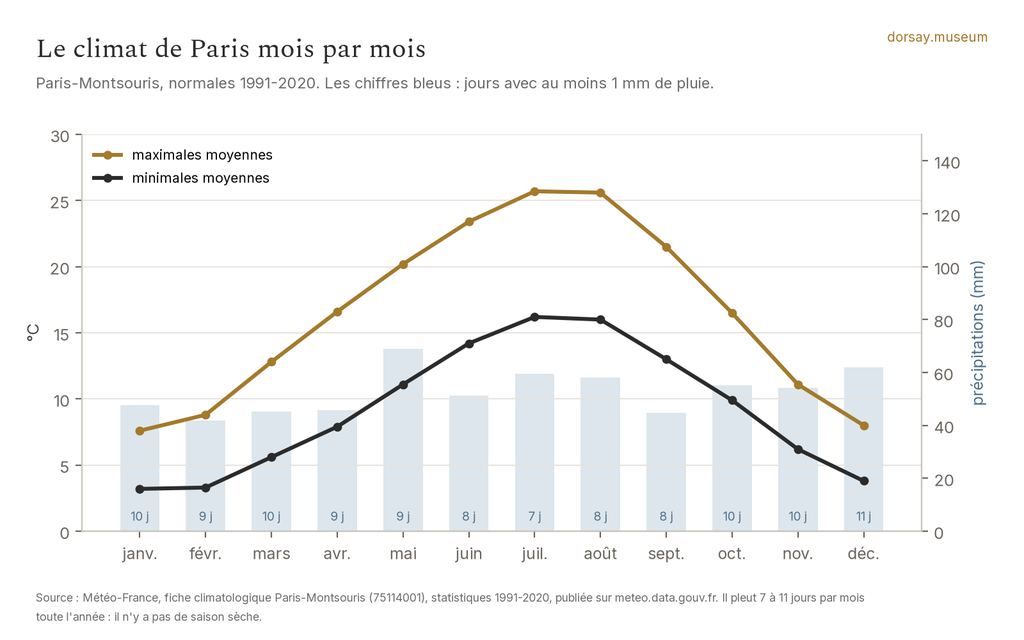
| Weather conditions for the queue outside Favorable: Maximum temperatures of 16 to 24°C, and fewer than 9 rainy days per month (April, June, September). These are the average conditions for Paris-Montsouris, based on data from 1991-2020. | 1 | 2 | 3 | 4 | 5 | 6 | 7 | 8 | 9 | 10 | 11 | 12 |
| Daylight upon exiting Favorable: Sunset after 6:00 PM, which is the usual closing time. This calculation is accurate to the minute for the 15th of the month. | 1 | 2 | 3 | 4 | 5 | 6 | 7 | 8 | 9 | 10 | 11 | 12 |
Indicators and proxies: hotel nights (Insee), Météo-France climate normals (1991-2020), astronomical calculations. These are not museum visits.
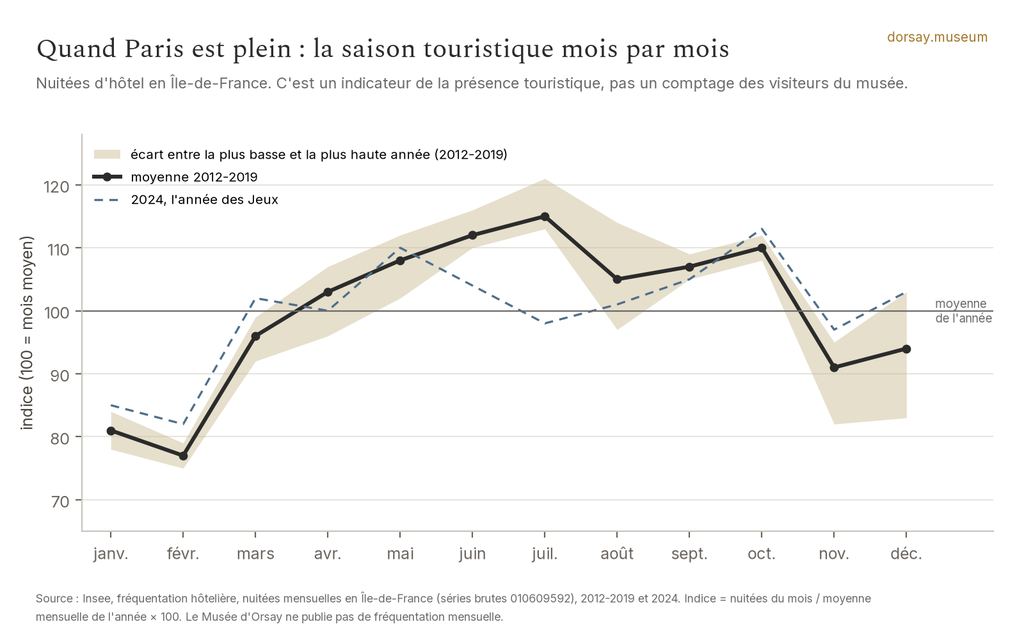
Quick overview: January and February are the only two months where the index remains below 85 in all the years studied between 2012 and 2019. June, July, and October reach or exceed 110. The rest of the year is between 91 and 108, with variations from year to year (November ranges from 82 to 95, and December from 83 to 103). Even July 2024 saw a decrease, to 98, during the Olympic Games. We cannot say whether the museum is emptier in January than in November: the indicator does not show this.
Why doesn't a hotel occupancy rate indicate the museum's visitor numbers?
Three reasons, detailed in the report. The overnight stays concern the entire Île-de-France region, not just the seventh arrondissement. French visitors, who stayed at home or with relatives, are not included in these figures. And a major exhibition is enough to attract hundreds of thousands of visitors: Le Modèle noir in 2019 attracted 505,000 visitors in 101 days, and Degas à l'Opéra attracted 477,000 visitors in 83 days before the end of the year (the exhibition lasted until January 19, 2020), according to the institution's activity reports. No hotel sees this.
Winter
January and February: calm, but cold and gloomy
The two months with the fewest tourists are also those with the least sunlight: on January 15th, the sun rises at 8:39 AM and sets at 5:21 PM, resulting in 8 hours and 42 minutes of daylight. The average high temperatures are 7.6°C in January and 8.8°C in February, with approximately 9 to 10 rainy days per month. Therefore, if there is a queue, it forms in the cold, but the museum provides shelter: timed tickets reduce the waiting time outside, without eliminating it completely.
To find out which entrance to use during the 2026-2028 construction work, please read the access, entrances, and opening hours section.
Which is the most convenient month, all things considered?
If we consider tourist activity, rainfall, and daylight, March and April stand out: the index is around 96 and 103, with maximum temperatures of 12.8°C and 16.6°C, and sunset at 6:55 PM and then 8:41 PM on the 15th of the month. This is our assessment, not a measurement: it is based on three indicators that have nothing to do with museum attendance. The spring break for zone C (the Paris area) falls in April and can significantly change things, as it brings families.
The calendar, month by month
The table uses the same sources and adds the structure of the calendar. The exact dates of school holidays change each year and are determined by the Ministry of Education; we only provide their position within the year here.
| Month | Tourist activity (index) | Maximum/minimum temperature, rainy days | Sunrise and sunset times on the 15th | Specifically, |
|---|---|---|---|---|
| January | 81, low | 7.6 / 3.2 °C, 9.9 days | 8:39 AM to 5:21 PM | The Christmas holiday period ends early next month |
| February | 77, the lowest | 8.8 / 3.3 °C, 9.1 days | 7:59 AM to 6:10 PM | Winter break for Zone C |
| March | 96, average | 12.8 / 5.6 °C, 9.5 days | 7:04 AM to 6:55 PM | The switch to daylight saving time will take place at the end of the month |
| April | 103, high average | 16.6 / 7.9 °C, 8.6 days | 7:00 AM to 8:41 PM | Spring break for Zone C |
| May | 108, high | 20.2 / 11.1 °C, 9.2 days | 6:09 AM to 9:25 PM | European Night of Museums, a Saturday in May; closed on May 1st |
| June | 112, high | 23.4 / 14.2 °C, 8.3 days | 5:46 AM to 9:55 PM | Possible start of a heatwave (2.5 days with temperatures of 30°C or higher) |
| July | 115, the highest | 25.7 / 16.2 °C, 7.4 days | 6:02 AM to 9:49 PM | Start of the summer holidays; 5.5 days with temperatures of 30°C or higher |
| August | 105, high average | 25.6 / 16.0 °C, 8.1 days | 6:42 AM to 9:06 PM | The index remained high over the years (ranging from 97 to 114) |
| September | 107, high | 21.5 / 13.0 °C, 7.5 days | 7:26 AM to 8:04 PM | European Heritage Days, held on the third weekend of the month |
| October | 110, high | 16.5 / 9.9 °C, 9.5 days | 8:10 AM to 7:01 PM | Autumn school holidays at the end of the month; return to standard time |
| November | 91, low average | 11.1 / 6.2 °C, 10.4 days | 7:58 AM to 5:10 PM | Autumn school holidays at the beginning of the month |
| December | 94, low average | 8.0 / 3.8 °C, 11.4 days | 8:37 AM to 4:54 PM | Christmas holidays at the end of the month; closed on December 25th |
The first Sunday of the month is free all year round, but you need to book a time slot: that's the rule, and it's not a quiet day. The details are on the page about free admission.
Step 2: What day of the week?
The museum is closed on Mondays, May 1st, and December 25th, and open from 9:30 AM to 6:00 PM on other days. Its only daily visitor information comes from a 2021 page, which is no longer available on its website: Tuesdays and Sundays are listed as "high," Thursdays (excluding evening hours) and Saturdays as "moderate," and Wednesdays and Fridays as "average." The museum stated that this information was provided for guidance only and had no contractual value. On another page, about accessibility (dated 2022), it recommends visiting on Wednesday mornings, Friday mornings, or Thursday evenings starting at 6:45 PM for a quieter visit.
Why Tuesday? The museum doesn't explain it. We observe, without being able to confirm it, that the Louvre and the Musée de l'Orangerie are closed on Tuesdays (according to the websites of these museums): visitors who had planned to visit one of the two may be shifting their plans to the Musée d'Orsay. This is a hypothesis, not a fact. Another, equally plausible, possibility is that it's related to school groups: in 2025, the museum welcomed 8,206 school groups, representing 173,399 visitors, according to its January 2026 press release, especially during the week and during the school year.
Here's a detailed breakdown of the schedule, day by day
The complete schedule, with the three time slots and how we interpret them, is reproduced in the section on traffic levels. Please note that no time slot is presented as quiet: the levels range from "moderate" to "high."
Step 3: What time should you arrive?
The opening time is the most uncertain aspect. The guides contradict each other: some recommend opening at 9:30 AM, others suggest midday, and none of those we read are based on published visitor counts. We found no published time-related data from the museum. What is established are the opening hours: opening at 9:30 AM, last entry at 17:00, rooms closing from 17:30, and the museum closing at 18:00. On Thursdays, there is an evening opening: last entry at 21:00, rooms closed from 21:15, and closing at 21:45.
The timed ticket essentially dictates your arrival time: booking a specific time slot is "strongly recommended" for all visitors, and is mandatory for those with the Paris Museum Pass and on the first Sunday of the month. The museum requests that visitors arrive at least 15 minutes before the time slot indicated on the ticket, and warns that security checks at the entrance may slow down access. It does not provide any information about waiting times, and we are not inventing any.
What the Paris climate says
The Météo-France averages for the Paris-Montsouris station (1991-2020) indicate 634 mm of rainfall per year, distributed evenly throughout the year with no dry season: from 7 to 11 rainy days per month. May receives the most rainfall in millimeters (69), while November and December have the highest number of rainy days (10.4 and 11.4, respectively). In July, an average of 5.5 days exceed 30°C. These are averages: records, such as the 40.6°C in June 2026, do not reflect typical weather conditions.
The weather matters in two ways: the queue outside, and the walk before or after the visit. Inside the museum itself, it makes no difference.
Dates that change the visit
Four key dates are observed each year. The exact dates vary, which is why they are always stated as follows:
- the European Museum Night, on a Saturday in May: in 2026, the museum was open for free from 6 PM to 11 PM, with reservations required (last entry at 10 PM);
- the European Heritage Days, the third weekend of September: in 2026, the museum offered free guided tours, with registration at the reception desk, which is not the same as free admission for everyone;
- the first Sunday of the month, free with a reservation required;
- The school holidays for zone C bring families, and the museum offers activities in the events hall during all school holidays, including the summer holidays, starting in 2025.
A final factor that defies any schedule is: major exhibitions. Caillebotte attracted 587,858 visitors during 2024-2025. An event of this size has a greater impact than any difference between two months, and that is why the trends on this page remain trends.
Which combination should you choose based on your situation?
| Your priority | Here's what the sources say | Our suggestion |
|---|---|---|
| As few people as possible | January and February: The lowest hotel occupancy rates. Wednesday and Friday: "Average" occupancy levels compared to the 2021 data. | On a Wednesday or Friday in January or February, at the time of your scheduled appointment |
| Good weather | April, June, and September: Maximum temperatures range from 16 to 24°C, with fewer than 9 days of rain. | September, excluding the third weekend |
| Light emanates from it | Sunset after 6:00 PM from February to October. | From March to September, with a walk along the quays after the visit |
| Evening visit | On Thursday, closing time is 9:45 PM; the 2021 schedule indicates "average" attendance on Thursday evenings. | On Thursdays, please see the page about evening hours: [link to page about evening hours]. |
| Visit for free | On the first Sunday of each month, admission is required; free admission is offered for certain categories of visitors. | See the page about free admission: [https://dorsay.museum/quand-venir/gratuite-premier-dimanche/](https://dorsay.museum/quand-venir/gratuite-premier-dimanche/) |
| Traveling with children | School holidays bring families; activities are held in the community hall. | See our guide to visiting with family. |
Frequently asked questions about the best time to visit
What is the best time to visit the Musée d'Orsay?
There is no official public measure. The available indicators indicate that January and February are the months with the lowest tourist presence in Paris, and the museum classifies Wednesday and Friday as "average" in its 2021 schedule. No data indicates a quiet time, but the museum itself, on its accessibility page (for people with intellectual, cognitive, or psychological disabilities, dated 2022), recommends visiting on Wednesday morning, Friday morning, or Thursday evening starting at 6:45 PM for a more peaceful visit.
What day is the least crowded?
According to the 2021 visitor flow schedule, no day is described as quiet. Wednesday and Friday are classified as "moderate," Thursday and Saturday as "high," and Tuesday and Sunday as "very high." The museum is closed on Mondays.
Is Tuesday really the worst day of the week?
The museum classifies it as "important" in its 2021 schedule, similar to Sundays. The reason is not given. The closure of the Louvre and the Musée de l'Orangerie on Tuesdays is a possible explanation, but this is just our hypothesis.
Are there fewer people there when it opens or at noon?
The guidebooks contradict each other, and none of the ones we read provide visitor counts. The museum opens at 9:30 AM. If you have a timed ticket, your allocated time slot determines your entry.
Which months are the quietest?
According to the hotel occupancy index for the Île-de-France region (Insee, 2012-2019), January (81) and February (77) have the lowest occupancy rates, while July (115), June (112), and October (110) have the highest. It's the presence of tourists, not the museum's attendance, that drives these fluctuations.
Is there more traffic during school holidays?
No other museum can compare. The museum organizes activities for families throughout all school holidays, which suggests a significant number of family visitors, although the exact figures are not available.
How can I find out about real-time crowd levels?
The museum's 2021 guide recommended the "Affluences" app, which provides an estimate of waiting times by the hour. It is a third-party application: we are not familiar with its methodology.
Does a temporary exhibition increase the queue?
Probably, and by a significant margin: The Black Model attracted 505,000 visitors in 101 days in 2019. The museum does not publish data on the impact on waiting times.
Is the first Sunday of the month a particularly busy day?
No figures are published. A booking is mandatory for this free day. See the dedicated page.
Go further ahead in the calendar
Select a ticket
The prices, schedules, and audio guides are all available in the dedicated section.
Data verified on . Dorsay.museum is an independent website and is not affiliated with the Musée d'Orsay. The opening hours listed were taken from musee-orsay.fr on November 6, 2026. Politique éditoriale