
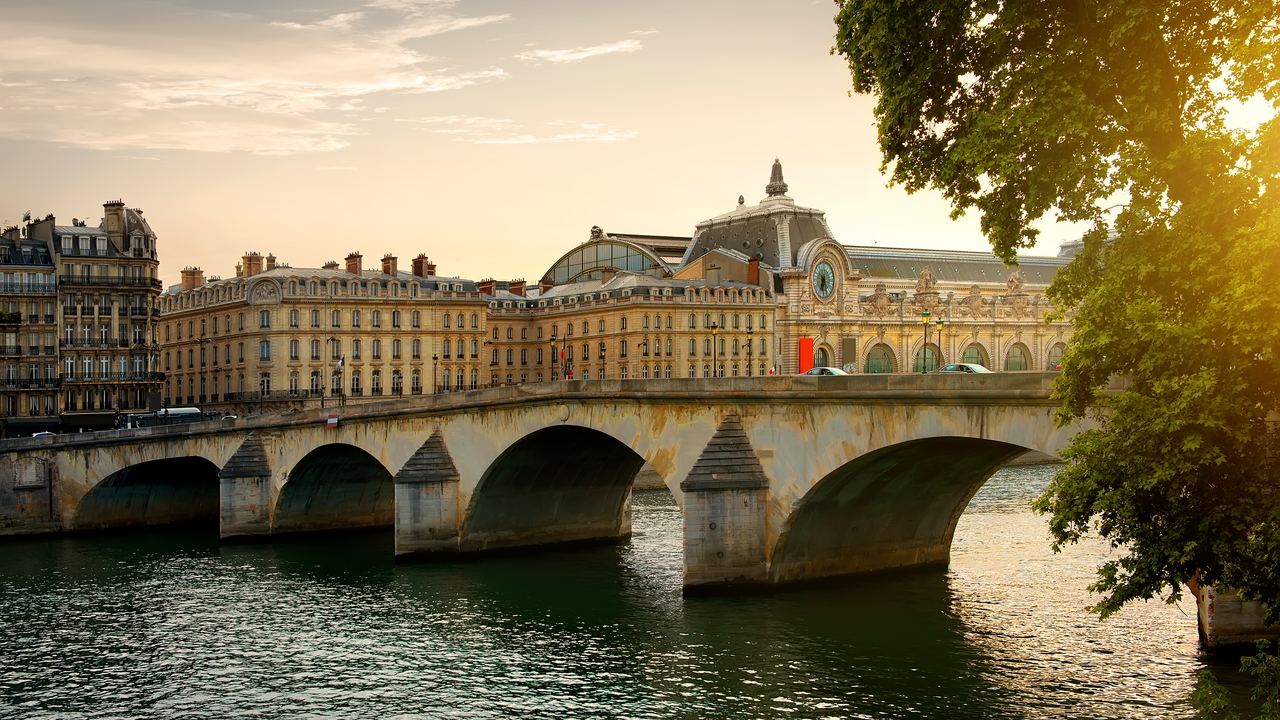
The Musée d'Orsay is located in the former Orsay station, built for the 1900 World's Fair, and showcases Western art from 1848 to 1914: painting, sculpture, decorative arts, and photography. It opened to the public on December 9, 1986. This page is a map of the seven sections we dedicate to its history and collections, with a timeline and figures for which we provide the source. dorsay.museum is an independent website, with no connection to the museum or the public institution that manages it.
What is the Musée d'Orsay?
It is a French national museum. The Ministry of Culture describes its mission as follows: to showcase artistic creation from the years 1848 to 1914 in all its diversity. The collections come from three institutions: the Louvre for artists born from 1820 onwards, the Jeu de Paume gallery for the Impressionists, and the National Museum of Modern Art for artists born after 1870.
Upon opening, the exhibition placed, face to face, in the large nave, Les Romains de la décadence by Thomas Couture, an academic painter, and Un enterrement à Ornans by Courbet. The ministry sees this as a way to distance itself from the condemnation of academic art. The museum has remained faithful to this idea: Manet, Rodin, and Art Nouveau furniture share the same building.
The figures for the collections vary depending on what is being counted. We have not found an official number of works on display, and we are not providing one. Wikipedia, which relies on the institution's activity reports, states that there are 151,288 works in 2023, including 5,412 works on loan outside the museum, and more than 5,150 paintings. These totals include drawings, photographs, and objects that are not on display: do not compare them to what you will see on the walls.
How the building is organized
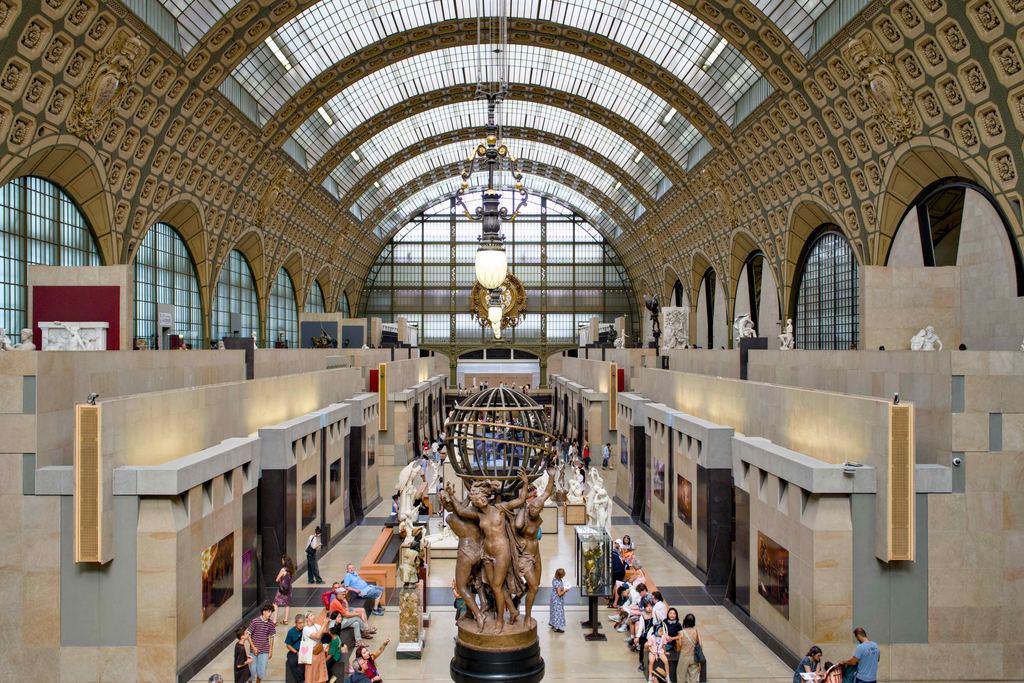
The transformation of the station is the work of the ACT-Architecture firm (Renaud Bardon, Pierre Colboc, and Jean-Paul Philippon). Their design preserved the main hall as the central element of the visitor experience and made the canopy the primary entrance. The exhibition spaces are organized across three levels: on the ground floor, the rooms on either side of the central hall; on the intermediate level, the terraces overlooking the hall; and on the upper level, above the vestibule along the platform. In addition to these levels, the museum site also includes the Amont Pavilion, the glass walkways of the main western facade, the restaurant, the bookstore, and the auditorium. The initial interior design was created by a team led by Gae Aulenti, with Italo Rota, Piero Castiglioni for the lighting, and Richard Peduzzi.
Twelve dates to understand the location
Each date is taken from the museum's website, the Mérimée database, or the Ministry of Culture, unless otherwise stated. The details, and any dates that the sources provide differently, are included in the document on the building's history.
The origins
-
1810
The Orsay Museum
The construction of the Orsay Palace began in 1810 and was completed in 1838, under the direction of Jean-Charles Bonnard and then Jacques Lacornée. It houses the Court of Auditors and the Council of State.
-
1871
The Commune fire
During the Paris Commune, the area was set on fire. The charred walls of the palace remained standing for about thirty years.
-
1898
Laloux selected
In 1897, the Compagnie d'Orléans consulted with three architects: Lucien Magne, Émile Bénard, and Victor Laloux. Laloux was selected in 1898.
-
July 14, 1900
The station and the hotel
The train station and hotel were inaugurated for the World's Fair. The main hall measures 32 meters in height, 40 meters in width, and 138 meters in length.
The growth
-
1939
Only the suburbs
The platforms have become too short for long-distance trains. The station now only serves the suburbs.
-
1973
The hotel is closing, and the train station is being listed [as a historical monument/site]
The hotel will close on January 1st. The train station, which is threatened with demolition, was added to the supplementary list of historical monuments on March 8th.
-
October 20, 1977
The decision
An inter-ministerial committee, convened at the initiative of Valéry Giscard d'Estaing, decided to create a museum dedicated to the 19th century in the former railway station.
-
1978
Ranking
The train station was designated a historical monument on March 15th. A public entity responsible for the renovation work was established on March 20th.
-
1979
The competition
The ACT-Architecture project was selected from among six proposals. Gae Aulenti will be in charge of the interior design.
Today
-
December 1st and 9th, 1986
Opening and launch
François Mitterrand inaugurated the museum on December 1st. It opened to the public on the 9th.
-
October 20, 2011
The redesign for the 25th anniversary
Pavillon Amont, a renovated Impressionist gallery, and a café redesigned by the Campana brothers (the "Café Campana" at the museum site, referred to as "Café de l'Horloge" on Wikipedia), according to Wikipedia.
-
2026-2028
Welcome materials
From March 10, 2026, to the summer of 2028, the museum will be renovating its visitor areas. However, it will remain open to the public, according to its website.
For the complete story, from the cavalry barracks to the RER tunnel, please read From the Orsay station to the museum.
How many visitors per year?
The museum received 3,785,134 visitors in 2025, according to a statement from the institution. The record remains that of 2023, with 3,871,498 visitors. In 2024, the year of the Olympic Games, attendance reached 3.75 million (3,751,681 according to the Ministry of Culture's figures). The pandemic caused the total to drop to 867,274 in 2020.
The Musée d'Orsay alone: 3,785,134 visitors in 2025. The Musée d'Orsay and the Musée de l'Orangerie combined, with the latter affiliated with the former since 2010: nearly 4.9 million visitors. When a report mentions "nearly 5 million visitors," it refers to the second figure (the combined total).
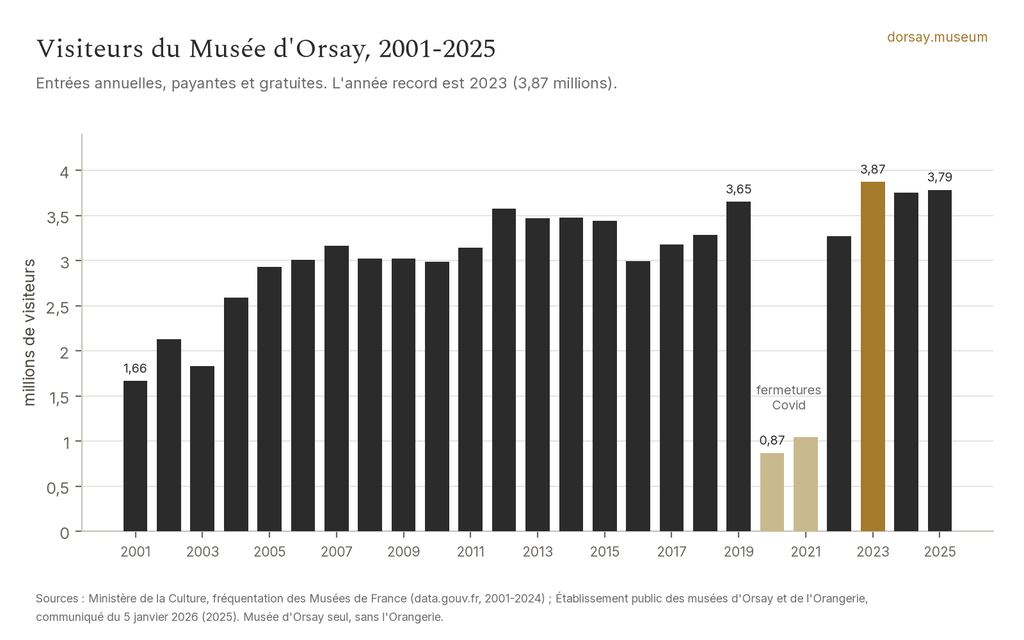
The complete series, the proportion of free entries, and the limitations of these figures are detailed in the Museum of Orsay Attendance document.
Major movements: key points
Realism: Gustave Courbet, with A Burial at Ornans (1849-1850, RF 325), brought the painting of everyday life to the scale of historical painting. Impressionism: The first exhibition of the group took place from April 15th to May 15th, 1874, at 35 Boulevard des Capucines, in the former studio of Nadar; the term comes from an ironic article by Louis Leroy in Le Charivari on April 25th, 1874. Eight more exhibitions followed until 1886, according to Wikipedia.
Post-Impressionism refers to what comes after and deviates from the movement: Cézanne, Van Gogh, Gauguin, and the Neo-Impressionism of Georges Seurat (The Circus, 1891, RF 2511). Symbolism with Gustave Moreau and Puvis de Chavannes; Nabis with Maurice Denis and his Homage to Cézanne (1900, RF 1977 137). Decorative arts and Art Nouveau complete the picture, particularly in the Amont Pavilion. The section on movements provides dates and an example artwork for each.
The seven files
Seven files, each focusing on a different aspect.
Masterpieces and their inventory numbers
Over 60 works are included, with detailed inventories, information on the techniques used, and the history of how they entered the collection.
Building history
From the Musée d'Orsay to the train station, from the train station to the museum, and the dates that contradict each other.
The eight Impressionist exhibitions
1874-1886: The Salon des Refusés and the Caillebotte Collection.
Paris: A City of Paintings
The real-life locations depicted by the Impressionists, and how to visit them.
Artistic movements
Realism, Impressionism, Nabis, Symbolism: dates, key figures, and examples.
Interesting facts and common misconceptions
True, false, or partially true: a verdict and a source are provided for each statement.
The glossary
Approximately one hundred terms related to 19th-century art.
Where should I start?
If you are planning a visit, start with the masterpieces: each artwork has its inventory number, which allows you to find it on the museum's website. If the building intrigues you, go directly to the history of the station. To understand how the Impressionists came to be in the museum, read about the eight exhibitions: the Caillebotte bequest of 1894 is the central episode.
What the Musée d'Orsay doesn't have
Some absences are surprising. The Mona Lisa is at the Louvre: the Orsay collections begin in 1848. Impression, soleil levant is at the Musée Marmottan Monet. The large collection of Water Lilies, bequeathed by Claude Monet to the state, is at the Orangerie; Orsay retains two paintings on the same theme. A Sunday on La Grande Jatte by Seurat is at the Art Institute of Chicago. The section on masterpieces lists these discrepancies, along with the correct location of each painting.
FAQ
What can you see at the Musée d'Orsay?
From 1848 to 1914, this collection features painting, sculpture, decorative arts, photography, and architecture, showcasing works by Manet, Monet, Renoir, Degas, Cézanne, Van Gogh, Gauguin, as well as Courbet, Millet, Rodin, and academic artists. The section on masterpieces includes over sixty works, each with its inventory number.
Why is the Musée d'Orsay located in a former railway station?
Because the Orsay station, which was decommissioned and threatened with demolition, was saved in the early 1970s. On October 19, 1977, an inter-ministerial council decided to establish a museum there dedicated to 19th-century art. The former station was designated a historical monument in 1978.
Can you see the Mona Lisa at the Musée d'Orsay?
No. The Mona Lisa is at the Louvre Museum. The Musée d'Orsay exhibits works from 1848 to 1914, while the Louvre displays those that predate that period.
Where can I see "Impression, soleil levant"?
At the Marmottan Monet museum, not at Orsay. Orsay has other Monet paintings, including La gare Saint-Lazare, Les coquelicots, and several Cathédrales de Rouen. The large Nymphéas are at the Orangerie, in the Tuileries Garden.
How many works are on display?
We were unable to find any official figures for the number of works on display. Wikipedia states that the collection contains 151,288 works as of 2023, of which 5,412 are housed elsewhere, but this total includes thousands of drawings and photographs that are kept in storage.
Will the museum remain open during the construction work?
Yes. According to the information on the museum's website, which I accessed on November 6, 2026, the museum will remain open throughout the duration of the renovations, from March 10, 2026, to the summer of 2028. All collections and exhibitions will be accessible. Only the entrances will be different, so please check the entrance before you visit.
Prepare the visit
The tickets, prices, and audio guides are all listed on a single page, with the prices clearly dated.
Data verified on . Dates: Musée d'Orsay website, Mérimée database, Ministry of Culture. Figures: data.gouv.fr and press releases from the institution. Politique éditoriale