
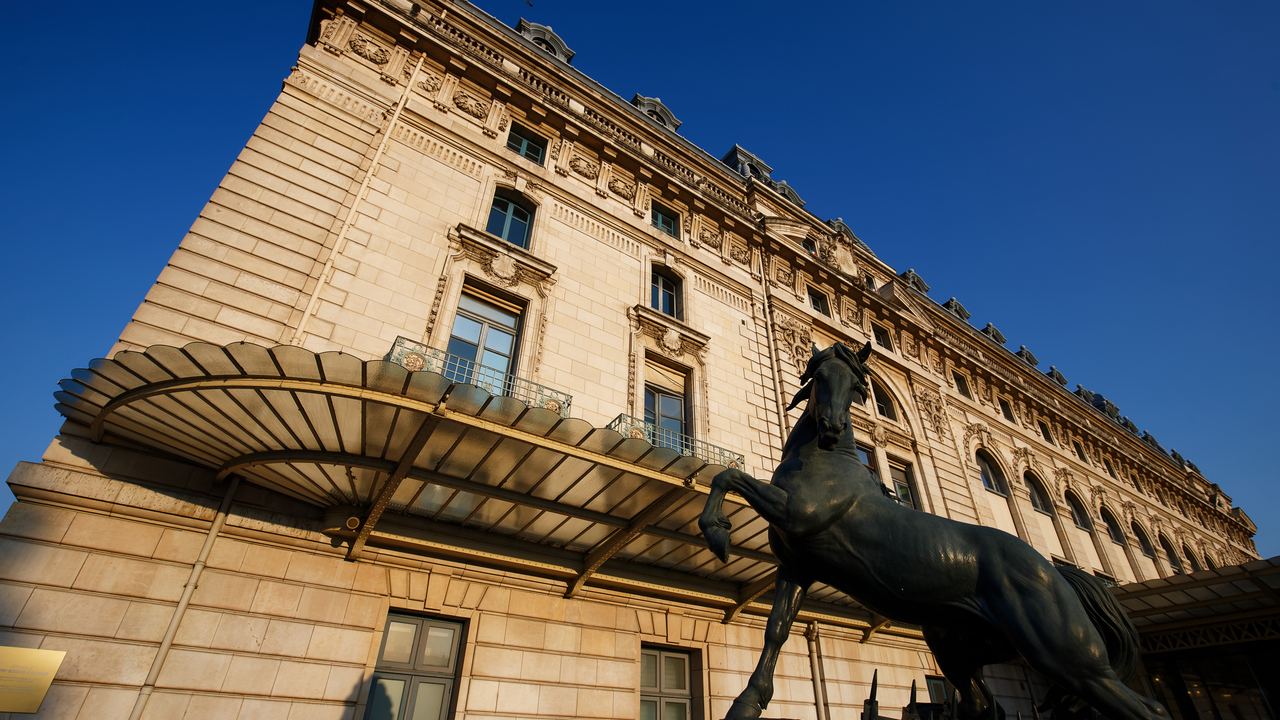
The Orsay station was inaugurated on July 14, 1900, along with its hotel, for the World's Fair. It lost its long-distance trains in 1939, closed its hotel on January 1, 1973, narrowly escaped demolition, and then changed its purpose: the decision to turn it into a museum was made on October 20, 1977, the inauguration took place on December 1, 1986, and it opened to the public on December 9. This page follows the building from its initial construction in 1810, to the work planned for 2026-2028, and clarifies the dates where sources differ.
Before the train station: the Orsay Palace, from 1810 to 1871
The land has a history older than the station. The Lille street follows the axis of the former garden of Queen Marguerite de Valois, the repudiated wife of Henry IV. Upon her death in 1615, the estate was sold in parcels, and along the river, a port, the Grenouillière, received trains carrying timber that had floated down the Seine. The Quai d'Orsay, started in 1708, was completed under the Empire, and the Hôtel de Salm, which became the Palace of the Legion of Honor, dates from 1782-1788. In the 19th century, the future site of the station housed two buildings: a cavalry barracks and the Musée d'Orsay, built from 1810 to 1838 by Jean-Charles Bonnard, and later by Jacques Lacornée.
Originally intended for the Ministry of Foreign Affairs, the palace was later assigned to the Council of State, which moved in in 1840. The Court of Accounts followed in 1842 (Wikipedia). Théodore Chassériau painted the frescoes in the main staircase of the Court of Accounts between 1845 and 1848, which represent his most significant work. However, these frescoes did not survive the year 1871: the palace was set on fire by the Paris Commune insurgents during the night of May 23rd to 1871, and its charred walls remained standing for about thirty years. According to the same source, only 60 square meters of frescoes, exposed to the open air for twenty-seven years, were salvaged before the demolition of the ruins in 1898.
Why is there a train station here, and who designed it?
On the eve of the 1900 World's Fair, the state ceded the land to the Compagnie des chemins de fer d'Orléans. Its Austerlitz station was located on the outskirts; it wanted a more central terminus, on the banks of the Seine, facing the Tuileries. In 1897, the company consulted three architects: Lucien Magne, Émile Bénard, and Victor Laloux. Laloux, who had just completed the city hall of Tours, was chosen in 1898. He is the author of the station. The other two participated in the consultation without designing it, which several online guides misrepresent by stating that "three architects" designed it.
The challenge was to integrate a train station into an elegant neighborhood, near the Louvre and the Palace of the Legion of Honor. Laloux conceals the metal framework behind an eclectic stone facade, and reserves modernity for the interior: inclined ramps and baggage lifts, elevators for travelers, electric traction, sixteen tracks in the basement, and reception services on the ground floor. The main hall measures 32 meters high, 40 meters wide, and 138 meters long; a vestibule and an open porch precede it along the quay. The station and its hotel were built in two years.
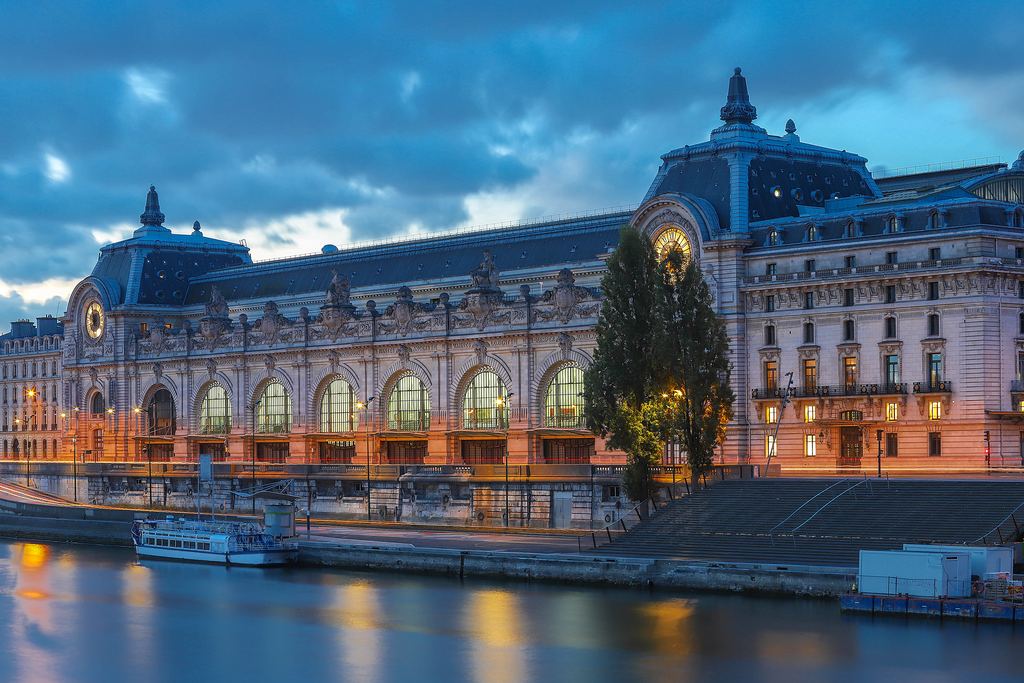
On this facade facing the Seine, eighteen names of cities recall the main destinations of the company: Agen, Albi, Rodez, Tulle, Poitiers, Limoges, Orléans, Bourges, Bordeaux, Toulouse, Nantes, Angers, Vannes, Lorient, Quimper, Aurillac, Blois, and Tours. Three monumental statues depict the three main cities: Bordeaux, Toulouse, and Nantes (Wikipedia). The hotel, at the end of the building, received travelers, but also associations and political parties that held meetings and banquets there.
The dates that contradict each other, and the one we are using
Regarding the station and the museum, the sources do not all provide the same date. Most of the time, they don't contradict each other; rather, they refer to two different events. We have chosen to use the information from the museum's website, the Mérimée database, and the Ministry of Culture.
| The point | Here's what the sources say | Key takeaways | Why |
|---|---|---|---|
| Station opening | May 28, 1900 (English Wikipedia); July 14, 1900 (museum website, Mérimée) | July 14, 1900: Inauguration of the station and the hotel | The museum's website and the Mérimée record both state "inaugurated on July 14, 1900." However, May 28th marks the opening of the railway line; do not refer to this as an inauguration. |
| Station architect | "Three Architects" (mentioned in several guides); Laloux (museum) | Victor Laloux, who was selected in 1898 | Magne and Bénard consulted with him in 1897. Laloux was the sole designer of the station. |
| Building protection | 1973 or 1978 | The two: two distinct actions | Registration in the supplementary inventory on March 8, 1973 (museum site), and classification on March 15, 1978 (as recorded in the Mérimée database, which only mentions the latter). Neither date invalidates the other. |
| Architecture competition | 1978 or 1979 | 1979 | On March 19, 1978, the public construction entity was established. The Ministry of Culture and the museum site launched the design competition in 1979. |
| Museum launch | December 1st or 9th, 1986 | 1. Inauguration. 9: Open to the public | The press release from the Ministry of Culture, dated March 29, 2021, provides both pieces of information. The French Wikipedia summary only mentions the year ("opened in 1986"). |
| Who designed the museum? | ACT-Architecture or Gae Aulenti | Both are suitable for two different tasks | The ACT project (Bardon, Colboc, Philippon), selected in 1979 from among six proposals, completely transformed the building. Gae Aulenti oversaw the initial interior design. |
| Demolition threat | Projects from the 1960s (Wikipedia); building permit for a hotel, followed by intervention from the Minister Jacques Duhamel in 1971 (English Wikipedia); "rescue" in 1973 (Ministry) | Early 1970s, no specific year mentioned | The ministry states that a train station "threatened with demolition" was saved thanks to a press campaign. Sources cite either 1971 or 1973, depending on the document they are referring to: we do not specify the year. |
From 1939 to 1973: A station that changed its purpose
Starting in 1939, the station no longer served the city center, only the suburbs: its platforms had become too short due to the electrification of the lines and the lengthening of the trains. It then served as a dispatch center for parcels to prisoners of war, and later as a reception center for their return. After the call from Abbé Pierre in 1954, it became the "Station of Hope" and served as a warehouse (Wikipedia). From the early 1960s, it served as a backdrop for film shoots, including that of Orson Welles' The Trial, based on Kafka (filming took place from March 5 to June 5, 1962, and the film was released the same year). Later, the Renaud-Barrault company installed its Théâtre d'Orsay there, which opened in 1972 and remained until 1981, and the Drouot hotel held its auctions there during its reconstruction (Wikipedia).
The hotel remained in operation until January 1, 1973. It played a historical role: it was in its ballroom that General de Gaulle held, on May 19, 1958, the press conference that announced his return to power (museum website; the date comes from an INA notice).
Demolition avoided
In the 1960s, plans for the area did not spare the train station. Wikipedia mentions a glass hotel with a parallelepiped shape (a project by Guillaume Gillet and René Coulon), a residential block proposed by Le Corbusier, and a tower envisioned by Jean Faugeron. The Ministry of Culture summarizes: the abandoned station was "threatened with demolition" and "saved by a press campaign that convinced Jacques Duhamel to designate it a historical monument in 1973." A statement from 2021 clarifies that, under the presidency of Georges Pompidou, it was threatened with "being replaced by a luxury hotel."
The museum's website also notes that in 1973, the French Museums Directorate was already considering establishing a museum there, one that would showcase all the arts of the second half of the 19th century, and that the station "benefited from a renewed interest in the 19th century." The inscription on the supplementary inventory of historical monuments dates back to March 8, 1973.
From the initial project to the museum's opening, from 1977 to 1986
On October 20, 1977, Valéry Giscard d'Estaing convened an inter-ministerial meeting and decided to create a 19th-century museum in the former railway station. The Ministry of Culture described it as the state's first major cultural project, aiming to preserve historical architecture by giving it a new purpose, and attributed the idea for the museum to Michel Laclotte. The subsequent steps followed quickly: the railway station was designated as a historical monument on March 15, 1978, a public construction agency was established on March 19, 1978 (Jacques Rigaud became its president in 1981), and then the 1979 competition, in which the ACT-Architecture group was selected from among six proposals.
In the same year, 1979, the construction of a tunnel connecting to the Gare des Invalides was completed. Orsay station was then reduced to only four tracks and became an underground station on the RER C line (Wikipedia). The project was confirmed after the election of François Mitterrand. The architecture respects the work of Laloux while reinterpreting it: the large nave becomes the central axis of the layout, and the canopy serves as the main entrance. Gae Aulenti, along with Italo Rota, Piero Castiglioni, and Richard Peduzzi, unified the interior with stone flooring and wall coverings. Bruno Monguzzi and Jean Widmer designed the signage.
"The station is superb and looks like a Fine Arts Palace..." This is what the painter Édouard Detaille wrote in 1900, eighty-six years before the museum opened its doors (a quote reproduced on the Musée d'Orsay website).
On December 1st, 1986, President François Mitterrand inaugurated the new museum. It opened to the public on December 9th of the following year. The collections came from the Louvre (artists born from 1820 onwards), the Jeu de Paume (Impressionists), and the National Museum of Modern Art (artists born after 1870). It is important to note that François Mitterrand did not "purchase" the station, as is sometimes written; it belongs to the state, which had designated it as a historical monument eight years earlier.
Key dates, from 1810 to 2028
The key features of the building, with the date chosen when sources differ.
The origins
-
1810-1838
The Orsay Museum
Built by Jean-Charles Bonnard and later by Jacques Lacornée, it houses the Court of Auditors and the Council of State.
-
May 1871
The fire
The palace was burned down during the Paris Commune. Its ruins remained until 1898.
-
1898
Laloux selected
Following the consultation of 1897, the Compagnie d'Orléans commissioned Victor Laloux to design its new station.
-
July 14, 1900
Inauguration of the train station and the hotel
Sixteen underground tracks, a 138-meter-long hall, and a stone facade that conceals the framework.
The growth
-
1939
Only the suburbs
The platforms are too short for long-distance trains.
-
1962
A movie set
Orson Welles filmed his adaptation of Kafka's "The Trial" in the abandoned train station, and the film was released the same year.
-
1973
The hotel is closing, and the train station is being listed [as a historical monument/site]
The hotel closed on January 1st, and was added to the supplementary inventory on March 8th.
-
October 20, 1977
The museum's decision
Inter-ministerial council convened by Valéry Giscard d'Estaing.
-
1978
Ranking
Ranking took place on March 15th, and the public construction entity was established on March 20th.
-
1979
ACT-Architecture and the RER C train line
The group was selected from among six proposals. The tunnel leading to Les Invalides makes the Orsay station an underground station.
Today
-
December 1st and 9th, 1986
Opening ceremony, then opening
Mitterrand will inaugurate the museum on the 1st. The public will be able to visit starting on the 9th.
-
2026-2028
Welcome materials
From March 10, 2026, to the summer of 2028, the museum will be renovating its visitor areas while remaining open to the public (museum site).
What remains of the train station that can still be seen in the museum
The nave. The main hall of Laloux, 32 meters high under its glass roof, is the centerpiece of the museum: the exhibition route is organized around it, and the sculptures occupy the space where the old tracks used to be.
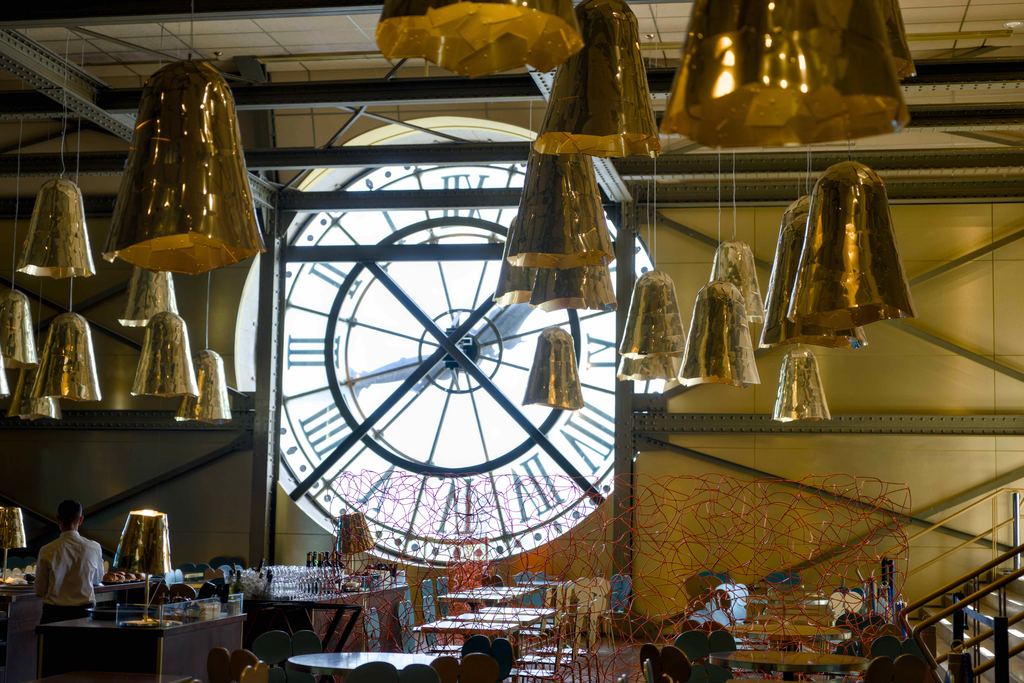
The clocks. The clock on the facade still bears the inscription "Paris-Orléans," the name of the company that built the station. Inside, a glass-enclosed clock offers a view of the Louvre and the Seine (Wikipedia). A museum cafe is located opposite one of the clocks on the facade: the Café Campana, designed by the Campana brothers (Wikipedia calls it the "Café de l'Horloge" during the 2011 renovation).
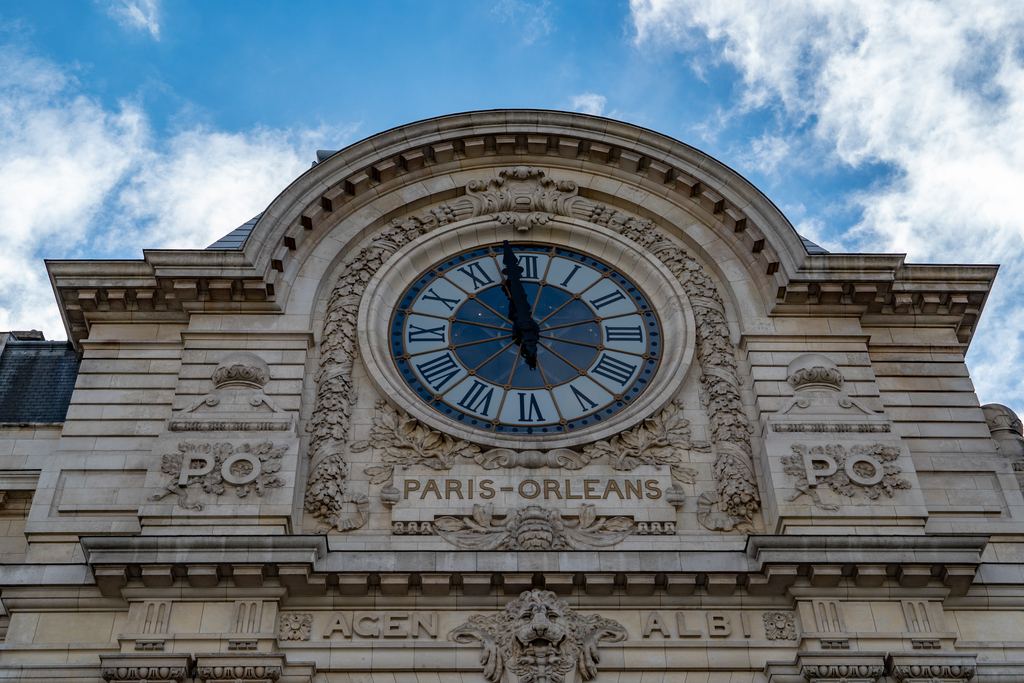
The clock and the company's name
On the facade of the old train station, the clock bears the inscription Paris-Orléans. It dates back to the time when people came here to catch the train to Bordeaux, Toulouse, or Nantes: it was the Paris-to-Orléans railway company that commissioned the building from Laloux.
The restaurant. According to the "History of the museum" page on the museum's website, the restaurant is located in the former dining room of the hotel; its "Dining" page mentions a restaurant and a small lounge, with ceilings painted by Gabriel Ferrier and Benjamin Constant.
Trains. There are always trains: beneath the museum, the underground RER C station has four platform tracks (Wikipedia). Therefore, the Musée d'Orsay remains a train stop.
After 1986: What has changed since the opening
In 2004, the museum transitioned from being a national service to a public administrative institution. In May 2010, the Musée de l'Orangerie was integrated into the same public institution. On October 20, 2011, coinciding with the museum's 25th anniversary, a partial renovation was inaugurated after two years of work: this included the creation of the "Pavillon Amont," a five-story building with 2,000 square meters of space, the renovation of the Impressionist gallery, a new café (currently the Café Campana, which Wikipedia refers to as the Café de l'Horloge), and a new temporary exhibition hall (Wikipedia).
On March 29, 2021, Culture Minister Roselyne Bachelot-Narquin announced that the name of Valéry Giscard d'Estaing, who died in December 2020, would be added to the name of the public institution, following a unanimous vote in the National Assembly on March 25th. The statement indicated that a decree would be issued by the Council of State to make the change official. Only the institution's name will change, becoming "Public institution of the Musée d'Orsay and the Musée de l'Orangerie – Valéry Giscard d'Estaing"; the museum itself will remain the Musée d'Orsay.
Since March 10, 2026, and until the summer of 2028, the museum is carrying out renovation work on its reception areas, in order to improve visitor comfort and reduce the environmental impact of the building. Its page dedicated to the works, viewed on November 6, 2026, specifies that the museum remains open throughout the duration of the construction and that all collections and exhibitions are accessible. However, the access points are changing: before visiting, check on our page about access and entrances to see which entrance to use.
Frequently asked questions about the station and its history
When did the Musée d'Orsay open?
It was inaugurated on 14 juillet 1900, along with its hotel, for the World's Fair. On May 28, 1900, they discussed the opening of the railway line, not the inauguration of the building.
Who built the Orsay station?
The architect Victor Laloux was selected in 1898 by the Compagnie des chemins de fer d'Orléans. Lucien Magne and Émile Bénard had been consulted with him in 1897, but they did not design the station. The construction project lasted two years.
Why did the Orsay station become a museum?
The station had only served the suburbs since 1939, and the hotel had closed in 1973. Facing demolition, it was saved, listed as a historical monument in 1973, and then classified in 1978. On October 20, 1977, an inter-ministerial council decided to turn it into a museum of the 19th century.
What do the clocks in the Musée d'Orsay represent?
The facade bears the inscription "Paris-Orléans," the name of the railway company that built the station. The interior pane, made of glass, offers a view of the Louvre and the Seine. We were unable to find any primary sources regarding their manufacture, so we cannot provide further details.
Are there still trains running to Orsay?
Yes: The underground station for the RER C line, which was connected to the Invalides station via a tunnel in 1979, has four platform tracks.
Is the museum restaurant located in the old hotel?
Yes: According to the "History of the Museum" page on the museum's website, the restaurant is located in the former dining room of the hotel. A museum entrance ticket is required, and the restaurant does not accept reservations. For opening hours and locations, see where to eat at the Musée d'Orsay.
Did Mitterrand inaugurate the museum in 1986?
Yes, December 1st, 1986. The museum opened to the public on December 9th of the following year.
The artworks that the station has become
The catalog of masterpieces provides the inventory number for each painting, as well as information about how it entered the collection.
Data verified on . Dates: Musée d'Orsay website, Mérimée database (reference PA00088689), Ministry of Culture. Information marked "Wikipedia": secondary source. Politique éditoriale