
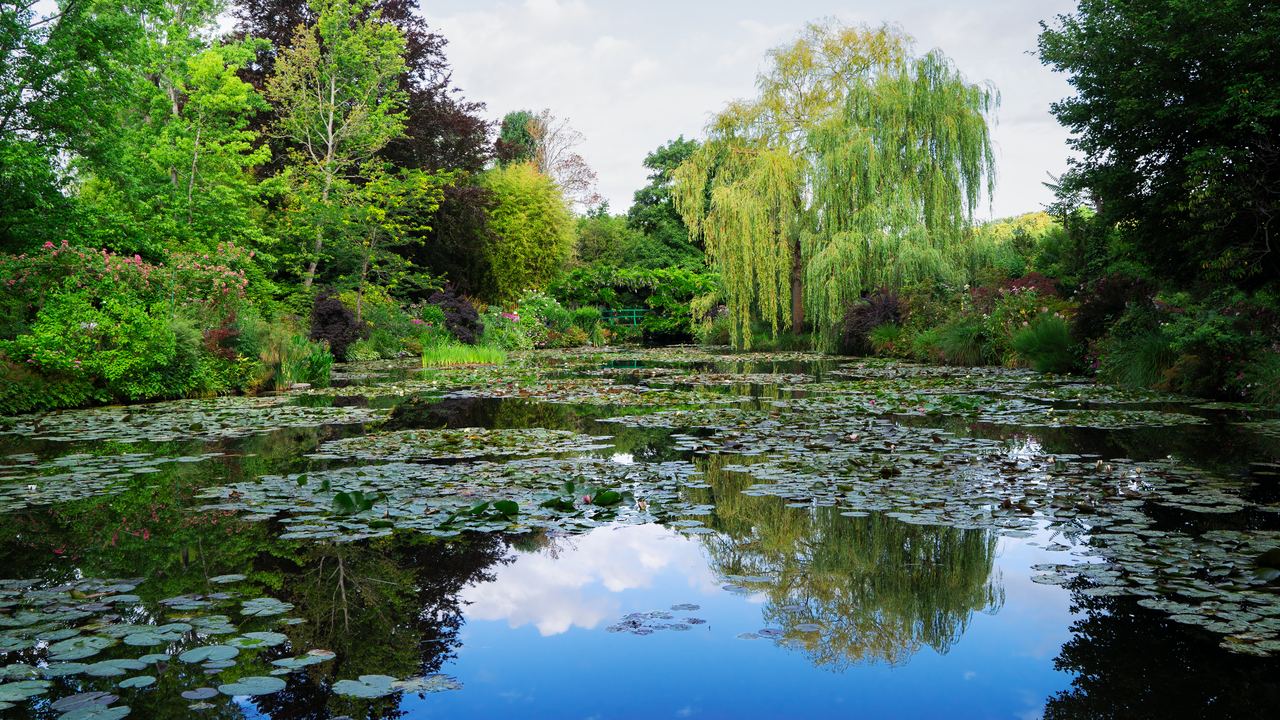
To see the Impressionists in Paris, the Musée d'Orsay is the first choice: it covers art from 1848 to 1914 and features works by Manet, Monet, Renoir, Degas, Morisot, Cézanne, and then Van Gogh and Seurat. The other three museums address a different question. The Orangerie is the place to see the Water Lilies, designed for its two oval rooms. The Marmottan Monet is dedicated to Monet alone, and features Impression, soleil levant (Impression, Sunrise). The Louvre is relevant for what came before, as its paintings mostly end around 1848.
We reviewed the schedules and collections on the websites of the Louvre, the Musée de l'Orangerie, and the Musée Marmottan on November 6, 2026. The distances are calculations from an OpenStreetMap pedestrian router starting from the entrance of the Musée d'Orsay, not measurements provided by the museums. No prices are displayed here: tickets are available on the tickets and audio guides page, and visits to two museums are available on the Orsay + Louvre and other visits page.
Four museums, four roles
The table compares the museums based on factors that are important when making a choice: what they cover, which Impressionist artists are represented, what days they are closed, and how far they are from the Musée d'Orsay. The Musée Rodin is listed last because it is located near the Musée d'Orsay, not because it focuses on the Impressionist movement.
| Museum | What it covers | Impressionist artists to see | Closed | From the Orsay Museum |
|---|---|---|---|---|
| Orsay Museum | Western art from 1848 to 1914 | Manet, Monet, Renoir, Degas, Morisot, Pissarro, Sisley, Cézanne; followed by Van Gogh, Seurat, and Gauguin | Monday, May 1st; December 25th | Starting point |
| Louvre Museum | European paintings from the 13th century to the late 19th century, with the majority of works dating from after 1848 being housed at the Musée d'Orsay | Almost nothing: it's a museum of what came before | Tuesday, January 1st, May 1st, December 25th | 980 meters, 13 minutes (pyramid) |
| Orangerie Museum | Monet's Water Lilies; the Walter-Guillaume Collection (148 works, from the 1860s to 1930) | Monet (Water Lilies), Renoir, Cézanne, a Sisley, a Gauguin | Tuesday, May 1st; the morning of July 14th; December 25th | 880 m, 12 min |
| Marmottan Monet Museum | Monet, Berthe Morisot, Impressionism, and Modern Art | Monet (including "Impression, soleil levant"), Morisot, Caillebotte, Degas, Pissarro, Renoir, Sisley | Monday, January 1st, May 1st, December 25th | 5.1 km, 68 minutes (RER C or Metro Line 9) |
| Rodin Museum | Rodin sculptures | No Impressionist painters: a sculptor of the same generation | Monday, January 1st, May 1st, December 25th | 1,440 meters, 19 minutes |
Which museum is open on which day?
The weekly closures are well-organized. On Mondays, the Musée d'Orsay and the Musée Marmottan are closed: the Louvre and the Musée de l'Orangerie remain open. On Tuesdays, the Louvre and the Musée de l'Orangerie are closed: the Musée d'Orsay and the Musée Marmottan remain open. From Wednesday to Sunday, all four museums are open. Keep in mind the practical consequence: to visit the Musée d'Orsay and the Musée de l'Orangerie on the same day, plan your visit from Wednesday to Sunday.
| Museum | Usual hours | Longer evening | Last access |
|---|---|---|---|
| Orsay | Tuesday to Sunday, 9:30 AM to 6:00 PM | Thursday, until 9:45 PM | 5:00 PM (9:00 PM on Thursdays) |
| Louvre Museum | 9:00 AM to 6:00 PM; closed on Tuesdays | Wednesday and Friday, until 9 PM | One hour before closing |
| Orangery | 9:00 AM to 6:00 PM; closed on Tuesdays | On Fridays, until 9 PM during exhibition periods | 5:15 PM (8:15 PM in the evening) |
| Musée Marmottan Monet | Tuesday to Sunday, 10:00 AM to 6:00 PM | Thursday, until 9 PM | 5:00 PM (8:00 PM on Thursdays) |
The Louvre specifies that the opening may be delayed, and that some rooms may remain exceptionally closed. It also evacuates its rooms half an hour before closing time. The Musée de l'Orangerie closes its galleries at 5:45 PM. The Musée Marmottan, on the other hand, closes its rooms a quarter of an hour before the museum's closing time. The opening hours for the Musée d'Orsay are listed on its "Visit" page; the hours for the other museums can be found on each museum's website.
The Musée d'Orsay: a comprehensive collection, encompassing the movement both before and after its peak
The Musée d'Orsay is the only one of the four museums to showcase the entire chain of artistic development. It begins with the precursors (Courbet, Manet, Bazille), then the Impressionists, and then what they inspired: Seurat, Van Gogh, Gauguin, and the Nabis. It also shows what they were rebelling against, academic art, with Cabanel's The Birth of Venus, which was purchased by Napoleon III at the 1863 Salon. According to the Ministry of Culture, its collections were formed from those of the Louvre, the Jeu de Paume, and the National Museum of Modern Art; the Impressionist works from the Jeu de Paume were transferred to the Musée d'Orsay, as the history of the Musée de l'Orangerie recalls.
Of Monet, you can see, among others, Les Coquelicots (1873, donation Moreau-Nélaton, 1906), La Gare Saint-Lazare (1877, bequest Caillebotte), Régates à Argenteuil (circa 1872), the two Essais de figure en plein air from 1886, and five *Cathédrales de Rouen* (1892-1893), four of which are from the Camondo bequest of 1911. Of Renoir, Bal du moulin de la Galette (1876, bequest Caillebotte). Of Degas, La Classe de danse. The sections and artworks change location: please read the museum plan, the eight Impressionist exhibitions, and the movements explained.
What the Orsay museum doesn't show: Impression, soleil levant (at the Marmottan museum), the large panels of the Water Lilies (at the Orangery), and the end of Monet's life. It does have some Water Lilies (blue) (acquired in 1981), but these are not the ones from the Orangery: the painting is square and dates from a different period of the series.

The Louvre: What came before, not the movement
The Louvre is not an Impressionism museum, and this is the first misunderstanding to clear up before booking a "Musée d'Orsay + Louvre" day. According to Wikipedia, the painting department is dedicated to European art from the 13th century to the end of the 19th century, but most of the works dating from after 1848 are exhibited at the Musée d'Orsay, with the exception of the Hélène and Victor Lyon donation. Therefore, one goes there to understand the path taken: historical painting, portraiture, classical landscape, before Manet and Monet changed everything.
According to the schedule, the Louvre is open on Mondays from 9:00 AM to 6:00 PM, closed on Tuesdays, and remains open until 9:00 PM on Wednesdays and Fridays. The last admission is one hour before closing time. If your only interest is to see Impressionist paintings, you might consider skipping it. If you want to see both collections on the same day, the "combined visits" page explains the overlapping hours, the time needed for each, and the available offers.
The Orangery: featuring Monet's Water Lilies, as well as works by Renoir and Cézanne
Claude Monet offered the state his first two large panels the day after the armistice, on November 12, 1918, as a symbol of peace, according to the museum. The entire collection was installed at the Orangerie in 1927, a few months after his death. Monet designed it as a space: two elliptical rooms and eight compositions (Reflets d'arbres, Les Nuages, Le Matin clair aux saules, Les Deux Saules, Soleil couchant, Reflets verts, Matin, Le Matin aux saules), to create, in his own words, quoted by the museum, "the illusion of an endless whole, of a wave without horizon and without shore."
In 1952, André Masson described it as "the Sistine Chapel of Impressionism," as the museum notes. The two rooms are designed so that visitors stand in the middle of the panels, not in front of them.
The Walter-Guillaume Collection: The rest of the visit
The Orangerie also features the Jean Walter and Paul Guillaume collection, acquired by the state in 1959 and 1963: 148 works from the 1860s to the 1930s, according to the museum's website. In terms of Impressionism, it includes twenty-five works by Renoir, fifteen by Cézanne, one by Gauguin, one by Monet, and one by Sisley; the rest are from the 20th century (Picasso, Matisse, Modigliani, Soutine, Derain, Rousseau). Therefore, it's the right museum for a large number of works by Renoir and Cézanne, but not ideal for an overview of the movement.
The museum is open on Mondays, from 9 AM to 6 PM, and closed on Tuesdays. It recommends booking a time slot online, noting that the wait time may be long. It also lists, on its website, a combined ticket for the Orsay and Orangerie museums, which is sold at the ticket counter and not online: combined offers are available on the Orsay + Louvre and other visits page.
The Marmottan Monet Museum: Monet alone, and the painting that named the movement
The Marmottan is the only museum on the list that displays Impression, soleil levant (1872), the painting whose title gave its name to Impressionism. The Musée de l'Orangerie itself mentions it on its page dedicated to Monet: "Impression, soleil levant, 1872 (Musée Marmottan, Paris)." According to the Marmottan, this painting has been the cornerstone of its Impressionist collections since 1940, and in 1966, the museum became the universal heir of Monet through his son Michel: the house in Giverny, and more than a hundred paintings that remained in the family.
Here, we see the Monet that the studio kept: The Train in the Snow. The Locomotive (1875), The Bridge of Europe. Gare Saint-Lazare (1877), London, the Parliament, reflections on the Thames (1905), late Water Lilies, The Japanese Bridge, and Wisteria from the years 1918-1920. The museum also presents the collection of Berthe Morisot, which it claims to be the most important in the world, as well as works by Caillebotte, Degas, Pissarro, Renoir, and Sisley. These superlatives are theirs; we have not verified them.
In terms of practical information, the Marmottan museum is located at 2, rue Louis-Boilly (16th arrondissement): metro line 9, stations La Muette or Ranelagh, or RER C, station Boulainvilliers. The Musée d'Orsay station is also on the RER C, but please check that the train you are taking stops at Boulainvilliers. It is open from Tuesday to Sunday, from 10 am to 6 pm, and on Thursdays until 9 pm. Reservations are not required: tickets can be purchased on site.
Three museums, three moments in Monet's life
To avoid visiting the wrong museum, follow the trajectory of Monet's life. At the Musée d'Orsay, you'll find Monet's works from the 1870s and the series from the 1890s. At the Marmottan Museum, you'll see Monet's early works and pieces from his Giverny studio. At the Musée de l'Orangerie, you'll find Monet's later works, from 1914 to 1926.
| Museum | Works to identify | Years |
|---|---|---|
| Orsay | "Poppies"; "The Saint-Lazare Train Station"; "Regattas at Argenteuil"; "Five Cathedrals of Rouen." | 1873; 1877; around 1872; 1892-1893 |
| Musée Marmottan Monet | Impression, sunrise; The Train in the Snow; London, the Parliament; The Japanese Bridge | 1872; 1875; 1905; 1918 |
| Orangery | "Water Lilies," a collection of eight works displayed in two elliptical rooms | According to the museum, the period is 1914-1926 for the entire collection |
Common errors
Impression, soleil levant is not at the Musée d'Orsay, but at the Marmottan Museum. The large panel Water Lilies paintings are at the Musée de l'Orangerie, not at the Musée d'Orsay. The Street in Paris, Rainy Day by Caillebotte and A Sunday on La Grande Jatte by Seurat, which are often sought at the Musée d'Orsay, are at the Art Institute of Chicago. Finally, the combined Musée d'Orsay-Musée de l'Orangerie ticket is not just a reseller's product: the Musée de l'Orangerie lists it itself.
In what order, and for how long?
With a single day, combine visits to the Orsay Museum and the Orangerie Museum, which are 880 meters apart via the Tuileries Garden, from Wednesday to Sunday. Allocate most of your time to the Orsay Museum (see how much time to allocate) and approximately one to one and a half hours for the Orangerie: this is an estimated timeframe, not the actual duration of the museum visit. Reserve the Marmottan Museum for a half-day visit on a separate occasion, when you want to enjoy Monet's works alone and are willing to travel by RER or metro.
On Thursdays, the Musée d'Orsay remains open until 9:45 PM, and the Marmottan Museum until 9:00 PM. Choose one or the other; visiting both on the same evening is difficult. The Musée d'Orsay's evening hours have their dedicated page.
To go beyond simply choosing a museum
The eight Impressionist exhibitions
Dates, addresses, and artists from 1874 to 1886, and what the Musée d'Orsay holds from that period.
Paris: A City of Paintings
The real-life locations depicted by the Impressionists, both in Paris and beyond.
How much time should I allocate for a visit to the Musée d'Orsay?
Three options are available: a 1-hour tour, a 2-hour tour, and a half-day tour.
Around the museum
Walking distances to the Tuileries Garden, the Louvre Museum, and the surrounding area.
Frequently Asked Questions about the Impressionists in Paris
Where is "Impression, Sunrise"?
Where can you see Monet's Water Lilies in Paris?
Does the Louvre Museum exhibit Impressionist paintings?
Orsay or Musée de l'Orangerie?
Should you visit the Musée d'Orsay or the Musée Marmottan to see Monet's works?
Which museum is open on Mondays or Tuesdays?
Is it possible to visit the Musée d'Orsay and the Musée de l'Orangerie on the same day?
Where can you see Van Gogh's works in Paris?
Should I make a reservation?
Visiting both the Musée d'Orsay and the Louvre in the same day?
On a separate page, we compare the walking distances, the recommended order of visits, and any combined offers available on days when both locations are open.
Data verified on . Opening hours and collections reviewed on November 6, 2026, for the Louvre, Musée de l'Orangerie, Musée Marmottan, and Musée Rodin; distances calculated using OSM data. Politique éditoriale