

Yes, the Musée d'Orsay can be visited with children, and it's better than you might think if you give up the idea of "seeing everything." Admission is free for minors; children under 13 must be accompanied by an adult; strollers are allowed, and the museum has a baby care area on level -1. For children under 12, they rent a youth-oriented audio guide with 52 listening points, built around three themes: landscapes, portraits, and animals. Further down, there's a themed tour that you can do without making any reservations, with a question to ask the child in front of each artwork.
The information provided by the museum comes from its "Families" section and its visitor regulations, reviewed on 6 November 2026. The durations and suggested itineraries are editorial choices, presented as such. The artworks change location, and some are sometimes loaned out or undergoing restoration: no specific rooms are mentioned here, because the museum regularly rearranges its sections.
At what age is it suitable, and what does the museum offer?
The regulation does not specify a minimum age. It establishes an obligation: children under 13 years old must be accompanied by a responsible adult (article 16), and it prohibits carrying a child on one's shoulders (article 36). Furthermore, the museum organizes activities by age group. The table summarizes what the "Guided Tours for Families" page and the "Workshops" page announce; the programming, however, changes from one season to the next.
| Age | What the museum offers | Our expert advice |
|---|---|---|
| Under 3 years | A family visit, designed to be engaging for babies and featuring sensory experiences, as announced by the museum | Half an hour: exploring the baby area on level -1, then the main hall and its sculptures, followed by the exit |
| 3-5 years old | Family visits that engage the senses, featuring drawing, artistic gestures, and animals | Forty-five minutes: dedicated solely to the "animals" section |
| 6-8 years old | Workshops for children (2 hours, including 45 minutes in classrooms), family visits | One hour: animals and clocks |
| Ages 9-12 | Workshops, storytelling tours, dance performances, and botanical tours – activities for children aged 6-12 at the "Les Petits M'O" site | One hour and thirty minutes: three chapters out of four |
| From ages 12 and 13 | Family visits for teenagers; general visits for adults aged 13 and over | Two hours, or a museum visit: see the "choose your visit" page |

Stroller, baby, meals: what you can bring
Strollers. According to the family section, strollers, baby carriers, and prams that are too bulky are not allowed, but the museum lends out strollers at the coat check in exchange for a form of identification. The regulations specify that umbrella strollers are permitted; prams, large strollers, and baby carriers are to be left at the coat check. There is no mention of baby carriers (slings); if in doubt, ask the staff at the entrance. The entire route is accessible by elevators and ramps; escalators are not permitted with a stroller.
Baby. The museum indicates a "baby area" on level -1, near the adult group reception. Its page does not detail the equipment: we do not guarantee a changing table or bottle warmer.
Food and drinks. The regulations prohibit eating or drinking outside of designated areas, but water bottles can be filled at the fountains on level -1 (Lille side) and at the back of the nave, near the Paris area. The restaurant and cafes are located within the museum; details about them can be found on our where to eat page. Luggage larger than 56 x 45 x 25 cm is not allowed. Large backpacks can be stored in the free cloakroom, and those arriving with luggage should use the "Parvis" entrance (see what to bring).
Tickets. Those under 18 years old enter free of charge, as do 18-25 year olds who are citizens of the European Union or the EEA (museum pricing page). For adults accompanying them, the museum offers a "Child & Companion" rate: a maximum of two adults, residents of the European Union, with adult and youth tickets booked together online. The prices are on the tickets and audio guides page.
The ticket is valid for one entry, and "all exits are final," according to the museum. If you are visiting with children, plan to have lunch inside the museum, or be prepared not to be able to re-enter.
The audio guide for children under 12, and what can be downloaded
Launched in November 2021, the audioguide for young audiences offers 52 points of interest throughout the collections, grouped around three themes: landscapes, portraits, and animals. The child can move freely and activate the audio tracks as they wish. Their guide is Pompon, a "learned and somewhat mocking" polar bear, who is named after the sculptor of The White Bear, perhaps not by chance. The version is available in French and English.
The museum is also putting online three booklets for families: one exploring the Impressionist gallery, another in the Amont pavilion where you can create your own stories, and a third focusing on the statues in the main nave. The website Les Petits M'O, designed for children aged 6-12, offers games, adapted information, and podcasts to enjoy before the visit. Finally, during each school holiday period, the Hall of Celebrations becomes a free space for relaxation and discovery, open to everyone, according to the family page.
A themed itinerary with no reservations required
The principle is simple: four chapters of about fifteen minutes, each with three or four artworks and a question that encourages you to look closely. The first three themes are the same as those in the audio guide for young audiences, and the fourth comes from the building itself, which used to be a train station. The artworks are drawn from our collection, taken from the Joconde database of the Ministry of Culture, which provides the inventory and the year, but not the location. To find the location of a work, ask a staff member or look for it on the guide map. If you can't find one, move on to the next. The important thing is the question.
The clocks, the train station, and the train
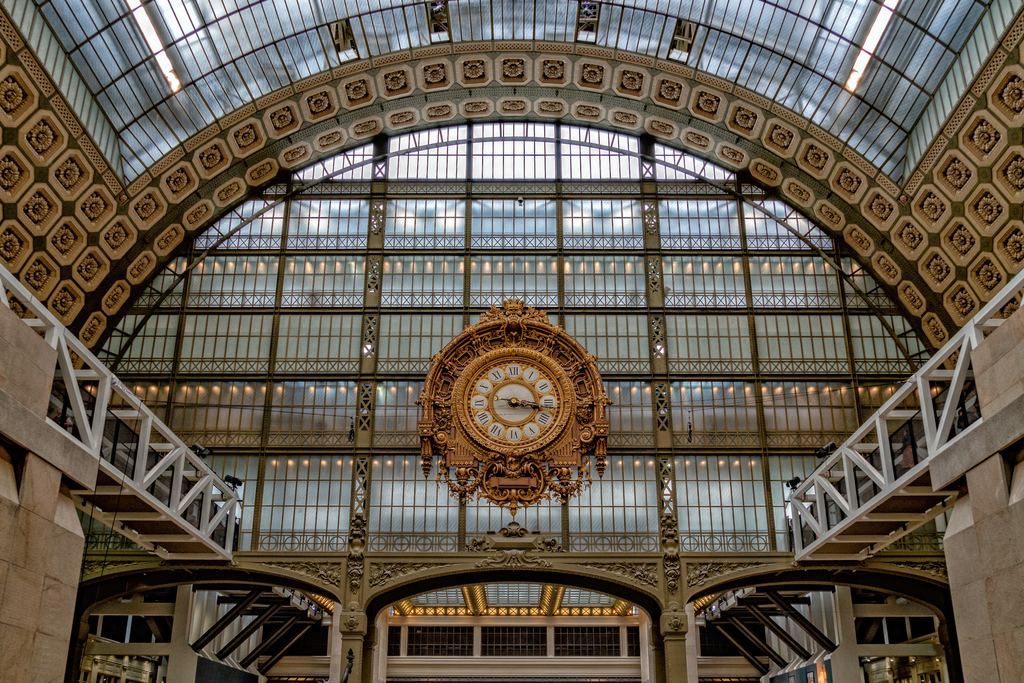
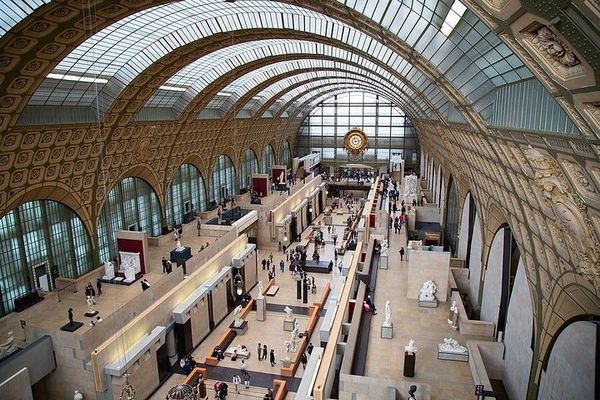
The simplest of treasure hunts begins inside the building. The museum is an old train station, inaugurated on July 14, 1900, and its large clocks have remained. The museum itself speaks of the "grand exterior clocks" on the facade, which can be seen from the inside as you exit the Impressionist gallery, from the Café Campana. Ask the child to find three clocks, and then to say what time each one shows.
For the train, Claude Monet painted ’The Saint-Lazare Station’ in 1877: a locomotive, steam, a glass roof. Compare it to the building where you are, which is also a train station.
| Theme | Artwork | Artist, year | Question to ask the child |
|---|---|---|---|
| Animals | Polar bear (stone) | François Pompon, 1925 | It lacks almost any detail: what makes it recognizable despite that? |
| Animals | The Magpie | Claude Monet, circa 1868 | Where is the bird? How did the painter depict the snow, which isn't white? |
| Animals | Young Greeks cockfighting | Jean-Léon Gérôme, 1846 | Who is watching the fight, and who is turning away? |
| Animals | The Snake Charmer | Henri Rousseau, 1907 | How many animals do you see in this jungle? |
| Portraits | Émile Zola | Édouard Manet, 1868 | What can you see on their desk? What does it reveal about their profession? |
| Portraits | Arrangement in Grey and Black No. 1, also known as Whistler's Mother | James Abbott McNeill Whistler, 1871 | Why does the painter give a portrait a musical title? |
| Portraits | Artist's portrait | Vincent van Gogh, 1889 | What is the background like around the head? What color are its eyes? |
| Portraits | The Clown Cha-U-Kao | Henri de Toulouse-Lautrec, 1895 | What is her profession? What indicates that? |
| Trains and clocks | Saint-Lazare Station | Claude Monet, 1877 | Where is the locomotive? What happens to the smoke under the glass roof? |
| Landscapes | Poppies | Claude Monet, 1873 | Where are the flowers? Where are the figures? Which ones appear further away, and which ones closer? |
| Landscapes | The Flood in Port-Marly | Alfred Sisley, 1876 | How high does the water rise? What do you do with a house that's flooded? |
| Landscapes | The Starry Night (over the Rhône) | Vincent van Gogh, 1888 | How many sources of light do you see, and where are they located? |
| Landscapes | The Circus | Georges Seurat, 1891 | What's happening on the track? Who is watching, who is playing? |
The bear, first of all. Pompon smoothed its surfaces and removed what he called its "embellishments," these decorative details, according to Wikipedia. The result pleases children because it is easily recognizable from a distance. The White Bear at Orsay is made of stone and was acquired by the state in 1926. It bears the inventory number RF 3269.
Then, the portraits. A portrait is understood by what surrounds the face. In Whistler's work, the title borrows from music (an "arrangement" in gray and black); in Van Gogh's, the background swirls around the head; in Toulouse-Lautrec's, the costume indicates the profession. A simple rule works well: the child describes what they see for ten seconds, and you say nothing.
Finally, the landscapes, to conclude with a scene where you can immerse yourself. Monet paints poppies with small touches of red, Sisley depicts a 1876 flood: these are real places that can be found around Paris (see the Paris of paintings). Seurat's The Circus, from 1891, is a good final stop for those who want to see it up close: it's a painting made of small dots of color. The Starry Night (over the Rhône), which is featured in the painting above, is on loan to the Tokyo Metropolitan Art Museum from November 14, 2026, to March 28, 2027; the date of its return to the gallery has not been announced.
How long, and at what point, should we stop?
It's better to stop before you get tired than after. Before the age of 8, one to one and a half hours is sufficient, and it's better to carefully read two chapters than to quickly skim through four. For children between 9 and 12 years old, a two-hour visit works well if the route alternates between large spaces and smaller exhibits. On Thursday evenings, the museum closes later, but this is not suitable for the youngest visitors: see the Thursday evening schedule. For the duration, depending on each person's pace, the how much time to allocate page offers three different routes.
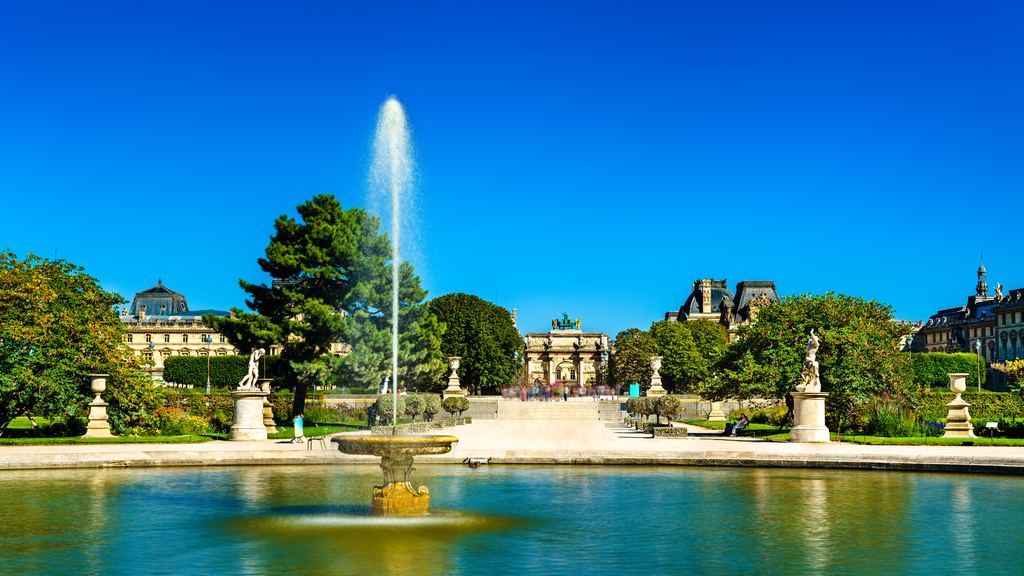
If you start to feel tired, take a break: the Tuileries Garden is about 750 meters away (a 10-minute walk, according to OpenStreetMap from the entrance). Please remember that the ticket does not allow you to re-enter.
Frequently Asked Questions about the Musée d'Orsay with Children
Is the Musée d'Orsay suitable for children?
From what age are visitors allowed?
Do children have to pay for admission?
Is it possible to enter with a stroller?
Is there an audio guide specifically for children?
Where can I change a baby's diaper or breastfeed?
How much time should you allocate when traveling with children?
Are there any games or activities that can be done before the visit?
When a guide adapts the tour to the age of the children
Private tours become a more reasonable option when traveling with children; the prices and available options are listed on the page, with specific dates provided.
2-hour private tour of the Musée d'Orsay with a certified art history guide
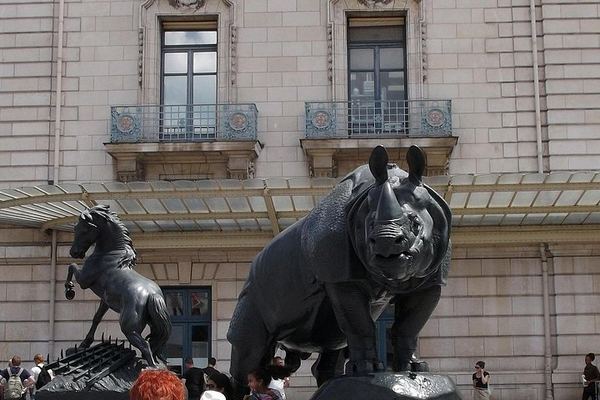
A two-hour private tour with a guide who holds an art history degree, skip-the-line ticket included: Van Gogh, Renoir, Degas, Cézanne and Manet. Six at most.
Custom 3-hour private tour of the Musée d'Orsay, including skip-the-line tickets
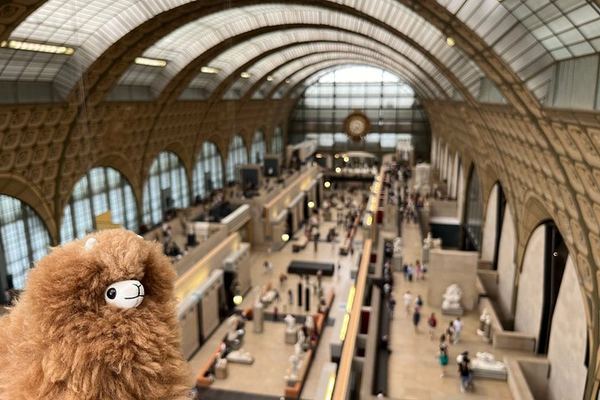
Three hours shaped around your interests with a private guide. The skip-the-line ticket is included for any booking made at least seven days in advance.
Essential private tour of the Musée d'Orsay, from academic art to Van Gogh
Sculptors, academic painters, then the Impressionists: a private tour of the 19th century at Orsay, with priority tickets and a guide in six languages.
Ratings collected by Viator and Tripadvisor
Prepare your bag before you leave
Stroller, water bottle, luggage, camera: these are the items that are allowed inside the museum, and those that must be left at the cloakroom.
Data verified on . The "Families" section and the museum's regulations were reviewed on November 6, 2026; artworks: based on the Joconde database. Routes and durations: editorial choices. Politique éditoriale