
Jenny Holzer: J'AI VU
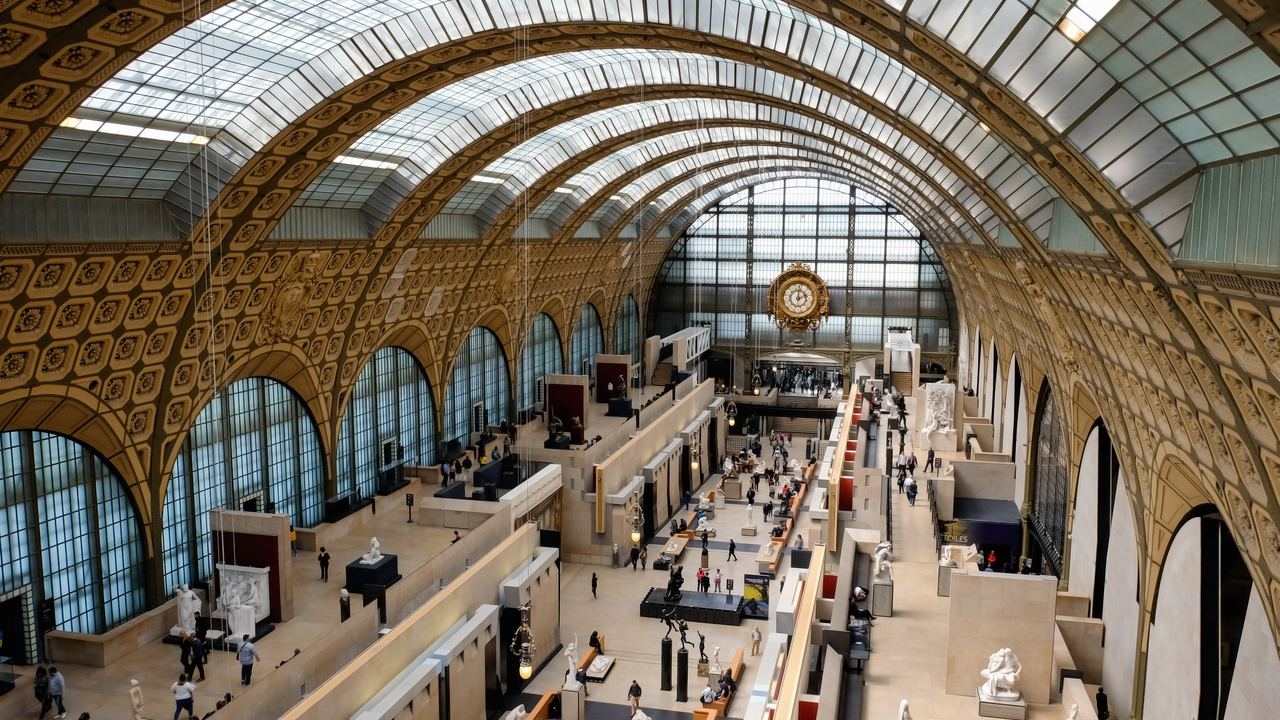
Jenny Holzer created "I SAW" using texts from the period covered by the Musée d'Orsay's collections. More than 750 excerpts, drawn from 424 sources and 73 authors, are displayed throughout the museum in the form of light projections, engravings, and paintings. The collection comprises letters from artists, literature, and political writings.
A LED installation runs through four rooms on the lower floor: historical painting, naturalism, symbolism, and the Courbet room. The text displayed changes in response to the movement of visitors, echoing the flow of people in the former train station. In the historical painting room, Holzer reconfigures the arrangement, focusing on the theme of war, bringing together the museum's collections with her own paintings using gold, platinum, and palladium leaf, which are dedicated to recent conflicts.
Other paintings are displayed in a room overlooking the Seine. These works reproduce texts that have been partially censored; the obscured passages raise questions about secrecy, exploring the tension between the need for confidentiality and the concealment of criminal acts. The light coming from the river changes the appearance of their metallic surfaces throughout the day.
Seventeen benches and two stone columns, created specifically for the exhibition, are located on the ground floor. The inscriptions carved on them mostly date from 1848 to 1914. Holzer researched the materials and the origin of the stones used in the sculptures and pedestals at the Musée d'Orsay in order to match them with those used in these nineteen new pieces.
The collection covers the Franco-Prussian War, the Paris Commune, colonialism, militant and anarchist movements, labor relations, and strikes. It also addresses the military—conscription, hazing, and corruption—the transformation of Paris under Haussmann, living conditions, art criticism, and the correspondence of artists.
The inaugural projections on the Seine-facing facade took place from October 18th to 22nd, 2026, from dusk (around 7 PM) to 11 PM. These five evenings have now passed; they do not represent a daily schedule for the remainder of the exhibition.
The exhibition is curated by Sylvain Amic, president of the institution, from April 24, 2024, to August 31, 2025, and Nicolas Gausserand, advisor in charge of international and contemporary affairs. This exhibition is part of the celebrations marking the fortieth anniversary of the Musée d'Orsay. The brochure and the list of sponsors are available on the official website.
Supporters mentioned by the museum
Dominique Mielle and Juan Carrillo; CELA INVEST; Cheryl Cohen Effron and Blair Effron; Marina Kellen French; Pascale Gérardin; Kendalle Getty; Andrew Gundlach; Kathy and Steven Guttman; Rosalind and Ken Landis; Richard Roth; Sylvie Winckler.